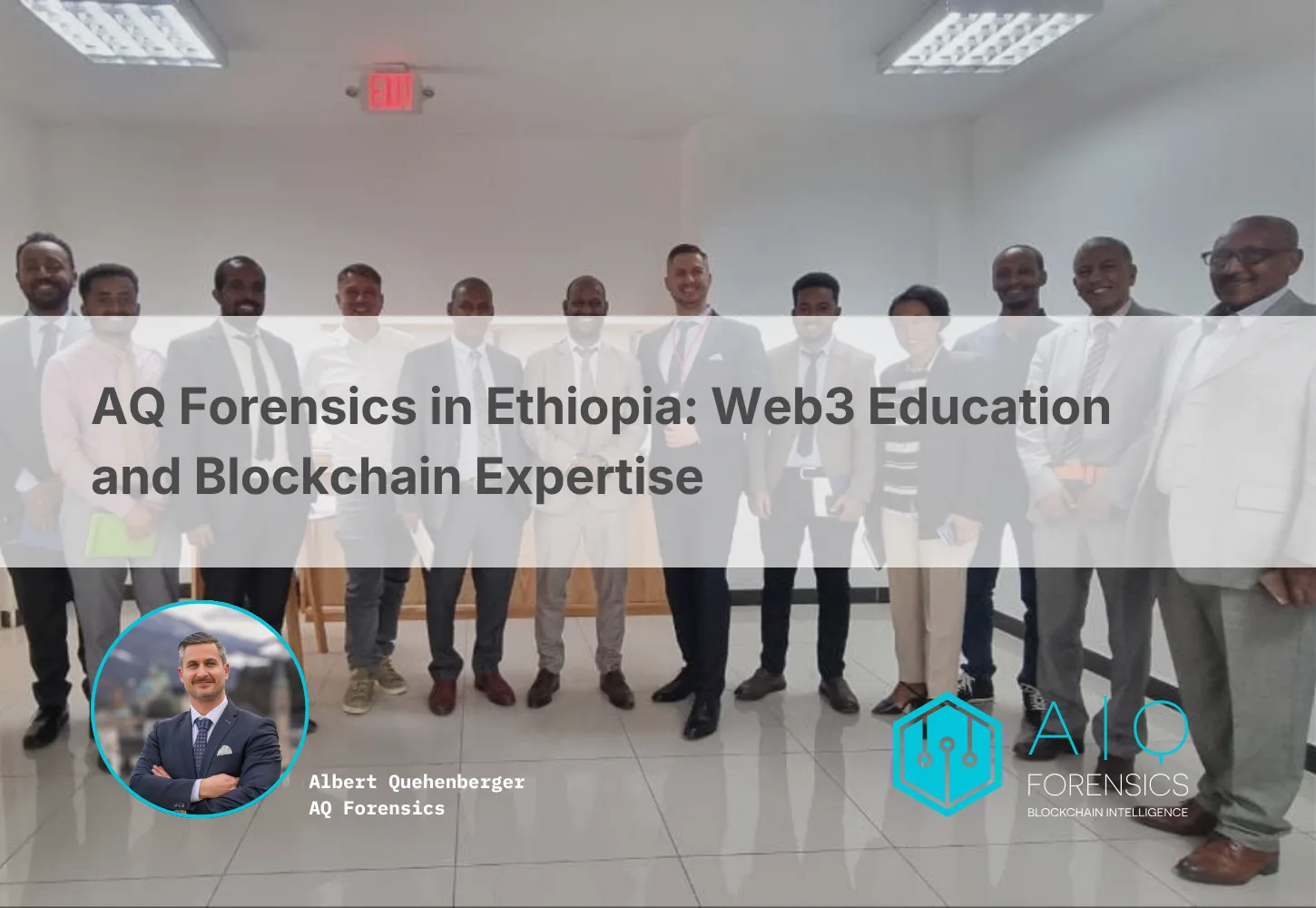
AQ Forensics in Ethiopia – A Country That Surprised Me. And a Web3 Generation That Could Make a Real Difference.
115 young talents, a vibrant blockchain community and fascinating encounters with developers, banks and public authorities. My trip to Ethiopia on behalf of sequa gGmbH gave me insights into a country I had heard a great deal about but actually knew very little about.
A Country I Had Heard Much About but Knew Little About
When sequa gGmbH commissioned me to travel to Ethiopia as part of a training programme, I did not need much time to decide. The project aimed to help 115 young talents prepare for a professional future in the Web3 sector.
sequa gGmbH is a German development organisation that implements projects worldwide to promote economic development and vocational training.
Until then, Ethiopia had been one of those countries I had heard a lot about without really knowing much about it. Of course, I was familiar with some of its historical and economic background. But I could hardly judge what the country actually looked like, how people lived or how far technological development had progressed.
As soon as I arrived in Addis Ababa, I realised that this trip would hold a few surprises.
Bole International Airport sits at an elevation of approximately 2,334 metres, making it one of the highest major international airports in Africa. The capital itself lies in the Ethiopian Highlands, which explains why the climate is surprisingly mild despite its geographical proximity to the equator. Daytime temperatures of around 20 to 25 degrees Celsius are not uncommon, while nights can be quite cool.
With around 139 million inhabitants, Ethiopia is one of Africa’s most populous countries. At the same time, the country is undergoing profound economic and technological change.
Electric Cars Everywhere You Look
One of the first surprises awaited me on the streets of Addis Ababa.
I have never seen as many electric vehicles in any other country as I did in Ethiopia. What you might expect in European metropolises can be seen here on practically every street corner.
There is an interesting reason for this. In 2024, Ethiopia banned imports of petrol- and diesel-powered vehicles, taking a remarkable step towards electric mobility.
Of course, this transition also presents challenges, including the expansion of charging infrastructure. Nevertheless, I found it remarkable how consistently the country has chosen a different path.
But electric mobility was not the only thing that surprised me.
A Web3 Community I Had Not Expected
I have worked professionally with blockchain technology, cryptocurrencies and their forensic analysis for many years. In that role, I regularly engage with developers, companies and a wide range of projects across the crypto sector.
Yet I had never experienced anything quite like what I encountered in Ethiopia.
Nowhere else had I previously met so many developers working on such a wide variety of blockchain and Web3 projects.
In numerous conversations, it quickly became clear that this was not simply about trading cryptocurrencies. Young people were engaging intensively with the technology itself, its potential applications and the question of how it could create professional and economic opportunities.
The figures also show that Ethiopia plays a noteworthy role in the international crypto sector. The country ranked twelfth worldwide in Chainalysis’s 2025 Global Crypto Adoption Index.
This is particularly remarkable because the regulatory framework for cryptocurrencies in Ethiopia continues to involve restrictions.
In any case, I was impressed by the technical knowledge, initiative and interest in new technologies that I encountered.
I had never experienced anything quite like what I encountered in Ethiopia.
Visiting iceaddis – A Pioneer of Africa’s Tech Scene
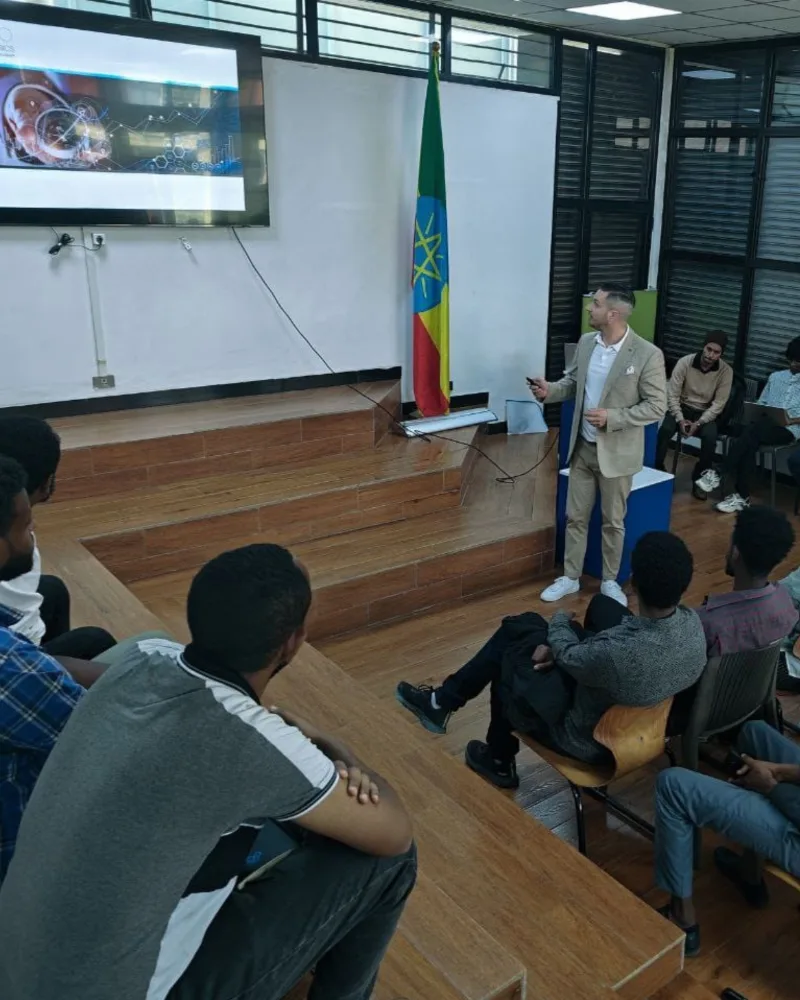
Another highlight of our trip was the opportunity to give presentations at iceaddis in Addis Ababa.
Founded in 2011, iceaddis is regarded as Ethiopia’s first technology incubator and one of the early innovation hubs in Africa’s startup scene.
It supports young entrepreneurs, developers and innovative startups in turning their ideas into concrete projects and business models. Its focus is on technological innovation, collaboration and creating economic opportunities.
I found it particularly exciting to learn which figures from the international technology and blockchain community had already been associated with this innovation centre.
As we learned on site, Ethereum co-founder Vitalik Buterin had visited only about two weeks before us. Jack Dorsey, Twitter co-founder and well-known Bitcoin supporter, was also said to have given talks there.
The fact that figures of this stature seek dialogue with African developers shows that technological developments on the continent have long attracted international attention.
For me personally, it was a wonderful experience to speak before this audience.
The conversations with developers and founders once again highlighted how much innovative potential Ethiopia has. I was particularly impressed that many projects focus on very specific problems and potential technological solutions.
iceaddis is a good example of how important such institutions are. They create spaces where knowledge can be exchanged, connections established and ideas developed further.
They also demonstrate that an active technology and startup scene does not necessarily have to emerge where large amounts of capital or perfectly developed infrastructure already exist.
115 Young People and the Opportunity for a Career in Web3
The main reason for my trip was to train 115 young talents. On behalf of sequa gGmbH, I had the opportunity to contribute my knowledge and practical experience in blockchain forensics and the international crypto sector.
It was particularly important to me not only to teach theoretical fundamentals but also to demonstrate how the technology is used in practice, what professional opportunities it opens up and what challenges come with it.
After all, blockchain and Web3 are not solely about cryptocurrencies or their price movements.
They encompass numerous professional fields, from software development and IT security to transaction analysis, compliance and combating financial crime.
In precisely these fields, new demands are emerging for professionals who understand both the technical fundamentals and their practical application.
Meeting the young participants was one of the most valuable parts of this trip for me. Their interest in the technology and willingness to engage with complex subjects genuinely impressed me.
I hope that my work made a small contribution to opening up new prospects for their professional futures.
Blockchain Expertise Is Also in Demand Among Banks and Authorities
Alongside training the young talents, the programme included several other interesting appointments.
I had the opportunity to give presentations to representatives of Ethiopia’s twelve largest banks and various government authorities.
From a professional perspective, I found these discussions particularly fascinating.
While many people still associate blockchain technology exclusively with cryptocurrencies, banks and government institutions face very different questions.
How can digital assets be traced? What opportunities does blockchain forensics offer for combating money laundering and financial crime? What risks must financial institutions consider, and what knowledge do authorities need to keep pace with technological developments?
These are questions we deal with at AQ Forensics every day.
Blockchain enables a degree of transaction traceability that often does not exist in the same form in traditional financial systems. However, this potential can only be realised if people receive appropriate training and the responsible institutions possess the necessary technical understanding.
That made the opportunity to discuss these topics with representatives of Ethiopia’s financial sector and public institutions all the more interesting.
These are questions we deal with at AQ Forensics every day.
What I Will Remember Most About Ethiopia
Beyond the professional impressions, there is one thing I especially want to highlight. I received an extraordinarily warm welcome in Ethiopia.
The hospitality, numerous encounters and openness of the people played a major part in making this trip such a positive memory.
I gained many new impressions and got to know a country that was different in many ways from what I had previously imagined.
Of course, Ethiopia faces considerable economic and social challenges. Nor is one trip enough to truly understand a country with almost 139 million inhabitants.
But it is enough to challenge some of my previous assumptions.
What I saw was a remarkable interest in technology, an active developer community and, above all, many young people willing to invest time and energy in their education and professional futures.
For me, this experience once again demonstrates that technological expertise is no longer confined to the familiar centres of Europe, North America or Asia.
In Ethiopia, too, people are developing, researching, learning and working on the technologies of tomorrow.
A Sad Memory of Prof. Dr. Philipp Sandner
This project is also associated with a very sad memory for me.
During the preparations, I had already succeeded in getting Prof. Dr. Philipp Sandner excited about the initiative.
Philipp was one of the most important figures in the German-speaking blockchain community. As a professor at the Frankfurt School of Finance & Management and founder of the Frankfurt School Blockchain Center, he worked for many years to make blockchain technology accessible to a wider audience and highlight its potential for business, academia and society.
His enthusiasm for the technology and for sharing knowledge would have been a perfect fit for this training project.
Sadly, that was not to be.
Philipp passed away on January 16, 2024, at just 43 years of age. His sudden death deeply affected us all and left a tremendous void, not only in the blockchain community but especially among those who knew and valued him personally.
It is particularly sad that he was unable to accompany this project.
Initiatives that give young people access to new technologies and open up professional opportunities also embody the goals he had championed for many years.
I would therefore also like to remember Philipp here, whose professional work and personal commitment left a lasting mark far beyond Germany.
A Personal Thank You
My special thanks go to sequa gGmbH for placing its trust in me and giving me the opportunity to share my experience as part of this training programme.
I would also like to thank all the participants, organisers and representatives of banks and authorities for the interesting conversations and open exchange.
Above all, I thank the people I met during my stay who welcomed me so warmly.
I returned home with many new impressions and a much broader perspective on Ethiopia.
And one thing is certain: I hope this was not my last trip to Ethiopia.
Über den Autor
Albert Quehenberger is the founder and managing director of AQ Forensics GmbH and a specialist in blockchain forensics, cryptocurrency investigations and digital asset analysis. With more than a decade of experience in intelligence, digital investigations and blockchain analysis, he supports companies, banks, lawyers, authorities and private individuals in investigating crypto fraud, tracing assets and analysing complex financial flows on public blockchains.
His professional career includes more than six years in military intelligence, a master’s degree from the WU Executive Academy, specialist training for court-appointed experts and training as an election observer under OSCE/ODIHR standards. He is also a member of the Expert Council of the European Institute for Future Generations (EIFG), a ChangeNOW Ambassador and an adviser to Web3 education programmes in Ethiopia.

Media & Further Reading
- sequa gGmbH – commissioning organisation for development cooperation and vocational training
- iceaddis – technology incubator and innovation centre in Addis Ababa
More AQ ECOSYSTEM Articles
- // AQ ECOSYSTEM 004 – AQ Forensics at the United Nations
- // AQ ECOSYSTEM 003 – AQ Forensics and Experts Train Cybercrime Investigators in Operational Blockchain Forensics
- // AQ ECOSYSTEM 001 – AQ Forensics at the Cardano Summit 2025 in Berlin