
Blockchain Forensics in Court Proceedings: Why Technical Fact-Finding Can Decide the Outcome of a Case
When blockchain data suddenly decides a case
In many crypto-related court cases the real problem does not begin with a complicated blockchain transaction, but with a very human situation: an investment turns out differently than expected. A payment is misinterpreted. An account is held in one person's name although someone else was in fact acting. Or an authority sees a technical overlap as a possible connection where in truth there is none.
This is exactly where blockchain forensics becomes relevant. Blockchain data may be permanently stored, publicly traceable and technically verifiable. But it does not explain itself. A wallet address does not initially reveal who is economically behind it. A transaction hash does not automatically say why a payment was made. And a deposit to the same exchange hot wallet is far from meaning that two people are connected.
In court proceedings, investigations, internal reviews and civil disputes, what matters is therefore not only that data exists. What is decisive is whether that data can be properly interpreted, compared with other records and translated into a comprehensible account of the facts.
Operational blockchain forensics builds exactly that bridge. It combines on-chain data with off-chain information: with case files, proof of payment, platform exports, IP addresses, login records, devices, contracts, statements and chronologies. Only from this does a reliable technical basis of fact emerge that lawyers, companies, authorities and courts can work with.
"Blockchain data does not speak for itself. Only forensic interpretation turns it into reliable evidence."
Blockchain forensics is not software analysis, it is fact-finding
A common misconception is to equate blockchain forensics with the use of analysis software. Specialised tools are of course important. They help to identify wallet clusters, recognise known platforms, obtain risk indicators and make transaction flows visible. But the tool is not the forensic work.
Software can indicate that an address might belong to a particular cluster. What it cannot readily assess is whether that supports a reliable conclusion in the case at hand. It does not automatically know the case file, the statements of those involved, the economic relationship, the market conditions at the time or the particularities of a platform's infrastructure.
In court proceedings this distinction is decisive. Courts do not need mere screenshots from analysis platforms. They need comprehensible findings:
- Which data was examined?
- Which assumptions were made?
- Which conclusions are established?
- Where do uncertainties remain? Which alternative explanations were ruled out or remain open?
Sound blockchain forensics therefore draws a clear line between technical observation, forensic assessment and legal evaluation. The legal evaluation remains the task of lawyers, courts and authorities. Operational forensics supplies the technical basis for it.
Case 1: When six years later it turns out there was no fraud
One particularly striking case began with an investment of a kind that was common in late 2017. A successful entrepreneur invested a six-figure euro amount in Bitcoin. He was experienced in business but, by his own account, not particularly versed in handling cryptocurrencies. He therefore turned to people from his private and professional circle whom he trusted to support him with the process.
These people set up an account for him at a platform that no longer exists today. The account was verified at the time, payments were made to the platform, exchange processes were documented. What probably felt like a tiresome formality back then became decisive years later: there were records. There were points of reference. There was a documented starting position.
That is one of the most important lessons from almost every crypto case: anyone who invests, trades or moves assets via platforms should document their transactions. Not only for tax purposes. Not only for their own overview. But also for the event that a dispute arises years later and what actually happened has to be reconstructed.
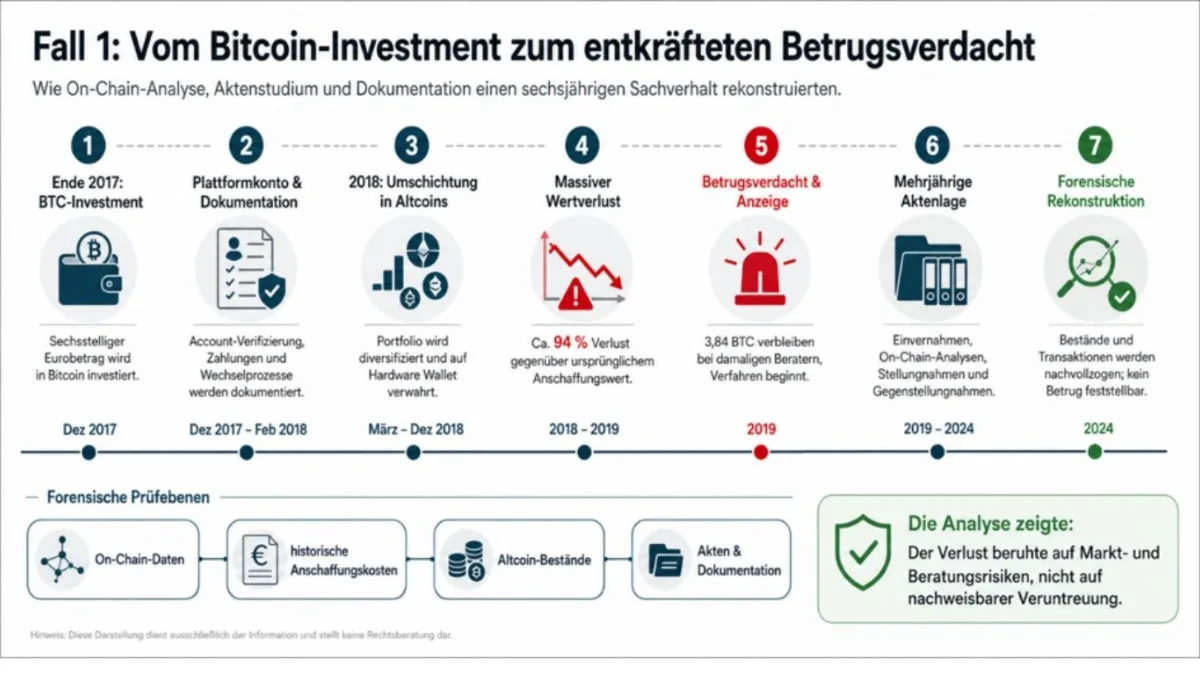
In this particular case the investment did not develop as hoped. In 2018 the Bitcoin price fluctuated heavily. The investor wanted to shift into altcoins. His advisers at the time diversified the portfolio and invested in numerous assets that were popular then. The assets were held on a Ledger hardware wallet.
A year later many of these altcoins had fallen sharply. Compared with the original acquisition value of the Bitcoin holdings, the portfolio had lost around 94 per cent of its value. From the investor's point of view it seemed likely that more must have happened than a poor market development. He felt he had been harmed and suspected fraud.
Of the original holdings, 3.84 BTC remained, in the possession of the advisers at the time. A criminal complaint was filed. Over the years extensive files accumulated: official interviews, on-chain analyses, statements, counter-statements, differing technical assessments. The proceedings lasted almost six years and placed a considerable burden on everyone involved.
When discontinuation of the proceedings was on the table, further civil action was to be prepared. At that point AQ Forensics was brought in.
The task was not spectacular in the sense of international money laundering structures, nested mixer constructions or highly complex DeFi transactions. Forensically, however, it was demanding: the entire case file had to be read, understood and compared with the blockchain data. Earlier statements had to be examined, opening balances reconstructed, altcoin holdings recalculated and historical acquisition costs taken into account.
In addition, it had to be established which platforms and wallets were involved at the time, even though wallet attribution was far less established in 2017 than it is today.
After several weeks of analysis a result emerged that hardly anyone had expected: there was no fraud. Apart from a few thousand euros, the original holdings and later reallocations could be traced. The economic loss was real, but at its core it was not based on concealed misappropriation; it was based on poor advice, unfortunate market decisions and severe price losses.
Blockchain forensics does not only serve to find incriminating facts. It can also exonerate. It can dissolve grounds for suspicion. It can prevent proceedings from being continued although the technical basis of fact does not support the allegation.
For court proceedings this neutrality is precisely what counts. A sound forensic analysis must not begin with the aim of confirming a particular result. It must reconstruct what the data can substantiate. Sometimes that incriminates. Sometimes it exonerates. And sometimes it spares everyone involved further years of costs, uncertainty and personal strain.
Case 2: How an exchange hot wallet led to a money laundering suspicion
The second case illustrates another typical danger in crypto-related investigations: technical misinterpretation.
A client was accused of money laundering. Together with his lawyer he had already spent several years trying to show that he had nothing to do with the suspected money laundering activities. The origin of the suspicion again went back several years.
The client was a Binance customer. He carried out a transaction to one of the platform's hot wallets. For people who work with crypto exchanges regularly, such a process is unremarkable. Large exchanges use operational pooled wallets through which deposits and withdrawals are continuously processed. Movement on such wallets can occur second by second.
A few minutes after our client's transaction, another Austrian user deposited to the same hot wallet. This second person was wanted on suspicion of serious commercial fraud. In the course of the investigation the authority was looking for reliable data on this person and their suspected money laundering network.
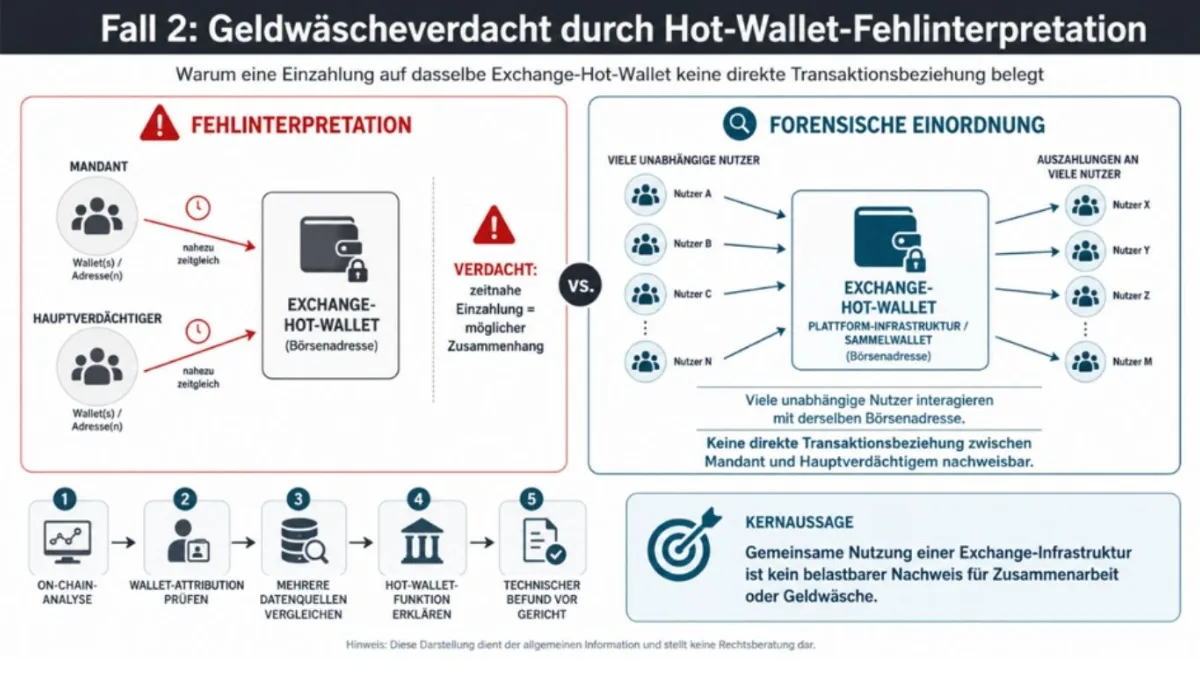
Because our client was also Austrian, had transferred to the same wallet almost simultaneously and came from a region similar to that of the main suspect, he too came into focus. The technical overlap was interpreted as a possible connection.
From a forensic point of view this was precisely where caution was needed. A deposit to the same exchange hot wallet does not mean that two users are connected. The hot wallet is part of the platform infrastructure. Many mutually independent customers pay into the same technical infrastructure. The situation resembles a pooled account rather than a direct payment between two people.
"Shared use of the same exchange infrastructure does not in itself establish any reliable connection between two people."
If this technical particularity is not understood or not sufficiently taken into account, a coincidental infrastructural overlap can turn into a serious suspicion.
In these proceedings, too, the client's documentation was important. He was able to present his own transactions, platform activities and records in a comprehensible way. AQ Forensics analysed the on-chain transactions, examined platform references and compared various data sources.
This revealed another important point: different blockchain analysis platforms do not always deliver the same results. That is not necessarily because one platform is „right“ and the other „wrong“. Providers work with different databases, attribution sources, heuristics, update states and commercially purchased data.
One platform may contain indications that another does not show. Conversely, official analyses may contain data points that are not directly visible in commercial tools.
This is precisely why, in analyses close to proceedings, it makes sense to examine several sources. Not in order to pick the desired result, but to make attributions plausible, identify contradictions and reduce the blind spots of individual data sources.
In this specific case the forensic evaluation showed that there was no direct transactional relationship between our client and the main suspect. The temporal proximity of the deposits was explicable by the way the Binance hot wallet works. No reliable personal or economic connection could be derived from the shared use of the same platform infrastructure.
AQ Forensics was summoned to court and was able to present the technical findings. The client was acquitted of the suspicion of money laundering. The main suspect was convicted in absentia.
This case shows particularly clearly how much precise technical interpretation can matter in court proceedings. Blockchain data is not only evidence. It can also be misunderstood. And when it is misunderstood, it can have serious consequences for those affected.
Case 3: When IP data, login records and on-chain traces only together form a picture
The third case makes clear that blockchain forensics often only unfolds its full strength when combined with classic digital traces.
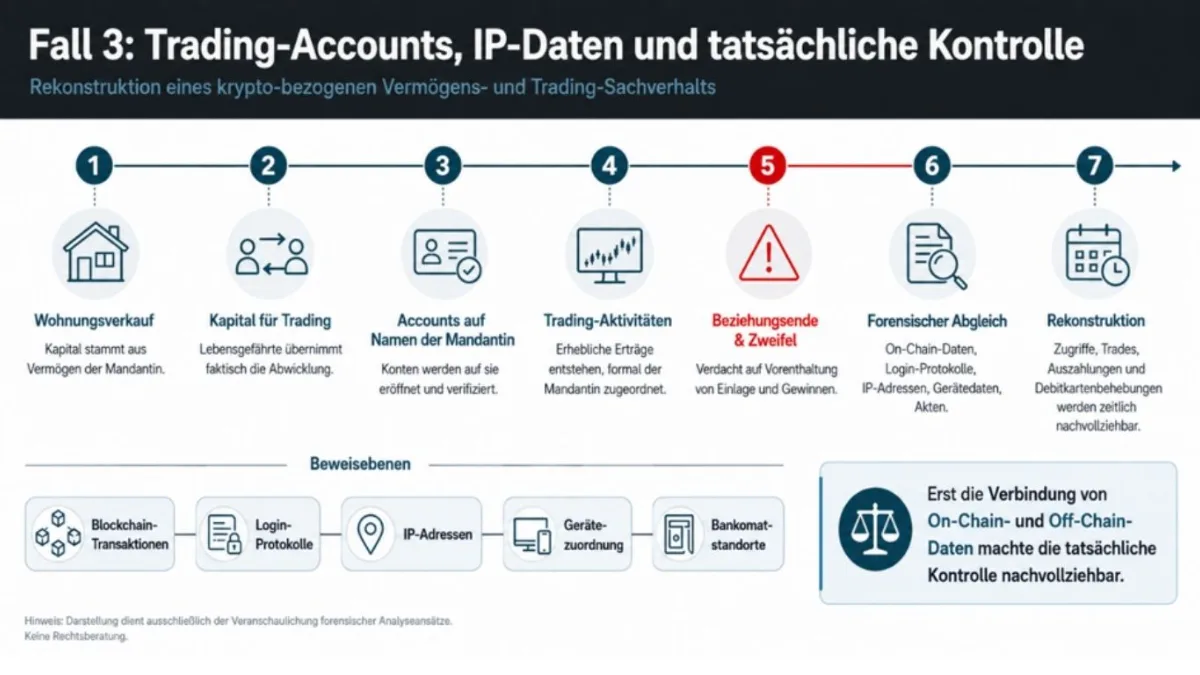
A woman approached AQ Forensics after having been severely disadvantaged financially by her then partner over a number of years. During the relevant period she was in poor health. Her partner at the time, who had relevant IT skills, pushed her to sell an apartment that had been awarded to her in an earlier divorce. He was to use the capital for trading activities.
The client agreed.
The partner registered as unemployed, later became a welfare recipient and officially moved back in with his parents. Outwardly it appeared that he had no notable income. Later, however, it turned out that trading had generated a six-figure annual return.
After the relationship ended, the client suspected that she had been deprived of her investment and of the trading profits. Here too it was remarkable how well she had documented everything. At the same time the case had already been handled by several parties. Two law firms and a tax consultancy had previously dealt with the matter.
The particular difficulty was that the trading accounts had been opened and verified in the client's own name. Formally, therefore, the accounts were attributed to her. Profits were consequently attributed to her as well. For the proceedings it first had to be established in a comprehensible way whether she had in fact traded herself or whether her former partner exercised de facto control over the accounts.
On-chain analysis alone would not have been enough for that.
"In many proceedings it is only the combination of on-chain and off-chain data that makes a reliable reconstruction of the actual facts possible."
What mattered was connecting different layers of data. The blockchain showed asset movements. Platform data showed account activity. Login records showed access. IP addresses could be assigned to particular connection ranges or ruled out. Device data provided further indications. Contracts, files and documentation added the chronological context.
The login data was particularly relevant. Many platforms record when a user logs in and from which IP address or device access occurred. The client's known IP addresses could be ruled out. That raised the question of whether accesses could be attributed to the former partner.
Here a detail that seemed unusual at first glance became decisive: the client had kept handover and return records, because she had at times lent mobile devices to her partner. In everyday life hardly anyone thinks of keeping such records. In this case they were of considerable value. They made it possible to attribute particular devices to the partner during particular periods.
When on-chain data, login records, IP addresses, device data and documentation were placed on a common timeline, a coherent picture emerged. It was possible to reconstruct when which accesses took place, which trades were placed, what results they produced and where funds subsequently flowed.
It also emerged that funds had been withdrawn using debit cards. The locations of the ATMs produced a movement pattern that matched the former partner's radius of movement.
This case shows that blockchain forensics must not be viewed in isolation. The blockchain provides an objective technical trace. But relevance in court often only arises through the combination with further evidence. Only when data sources are overlaid can it be reconstructed who may have done what and when, and what economic consequences followed.
What courts expect from blockchain forensic reports
The three practical cases involve different facts. What they have in common, however, is that the blockchain data alone would not have been sufficient.
Courts do not expect mere wallet graphics or screenshots from analysis platforms. What is decisive is that technical findings are documented comprehensibly, justified methodically and derived transparently.
A blockchain forensic report should therefore answer in particular the following questions:
- Which data was evaluated?
- Which analysis tools were used?
- Which assumptions were made?
- Which conclusions can be substantiated technically?
- Which statements are probable and which merely possible?
- Which alternative explanations were examined?
- Where are the limits of the analysis?
It is precisely this transparency that distinguishes a reliable technical analysis from a mere expression of opinion.
Another important aspect concerns traceability. Courts must be able to understand years later how a result came about. Professional blockchain forensics therefore documents every analytical step, data source and assessment in a comprehensible way.
The role of operational blockchain forensics
AQ Forensics sees blockchain forensics not as pure software analysis but as an operational investigative discipline.
This work includes, among other things:
- On-chain analysis of complex cryptocurrency transactions
- Wallet clustering and wallet attribution
- Exchange identification
- Asset tracing
- Securing evidence
- Reconstruction of payment flows
- Evaluation of platform data
- Linking on-chain and off-chain information
- Preparation of private expert reports admissible in court
- Support for lawyers, companies, banks and authorities
The explicit aim is not to make legal assessments or to anticipate court decisions. The task is rather to reconstruct technical facts objectively, prepare them comprehensibly and provide them as a reliable basis for further legal or official steps.
Particularly in complex international proceedings, fraud cases, money laundering investigations or commercial disputes, this form of technical fact-finding is becoming increasingly important.
Crypto transactions demand clarity. We deliver evidence you can trust.
AQ Forensics provides in-depth blockchain analysis, wallet risk assessments, source-of-funds verification, and forensic crypto investigations – independently, transparently, and with legally defensible findings.
In context
Blockchain forensics is increasingly becoming an important part of modern criminal proceedings, civil proceedings and commercial disputes.
Public blockchains store enormous amounts of objective data. Its actual meaning, however, only emerges through proper analysis and combination with further evidence.
This applies in particular to establishing the source of funds, where companies, banks or authorities have to assess the origin and plausibility of digital assets.
The cases presented show that blockchain forensics can do more than reveal incriminating facts. It can equally refute grounds for suspicion, resolve technical misunderstandings and help courts to interpret complex facts comprehensibly.
The more complex digital assets, international payment flows and blockchain technologies become, the more important a neutral, methodically sound and comprehensible technical analysis becomes.
Blockchain data provides valuable traces. Only its forensic interpretation, however, creates a reliable basis for courts, authorities, lawyers and companies.
Über den Autor
Albert Quehenberger is founder and managing director of AQ Forensics GmbH and a specialist in blockchain forensics, cryptocurrency investigations and digital asset analysis. With more than a decade of experience in intelligence, digital investigations and blockchain analysis, he supports companies, banks, lawyers, authorities and private individuals in investigating crypto fraud cases, asset tracing and analysing complex financial flows on public blockchains.
His career includes more than six years in military intelligence, a master's degree from the WU Executive Academy, specialist training for court-appointed experts and training as an election observer to OSCE/ODIHR standards. He is also a member of the expert council of the European Institute for Future Generations (EIFG), a ChangeNOW ambassador and an adviser for Web3 education programmes in Ethiopia.

Further analyses & case studies
- // AQ INSIGHTS 002 – Crypto mixers in blockchain forensics
- // AQ CASES 002 – Asset recovery in practice
- // AQ INTELLIGENCE 002 – OFAC sanctions suspected ISIS financiers