Escheat Estates: Why Digital Assets Have Long Been Part of Everyday Administration
When the state inherits Bitcoin: why digital estates have long been part of everyday administration
What happens to a Bitcoin wallet when its owner dies? What becomes of balances at crypto exchanges, PayPal or Wise, of locked smartphones, cloud storage or domains? And who takes care of it when, in the end, it is not relatives but the state itself that inherits?
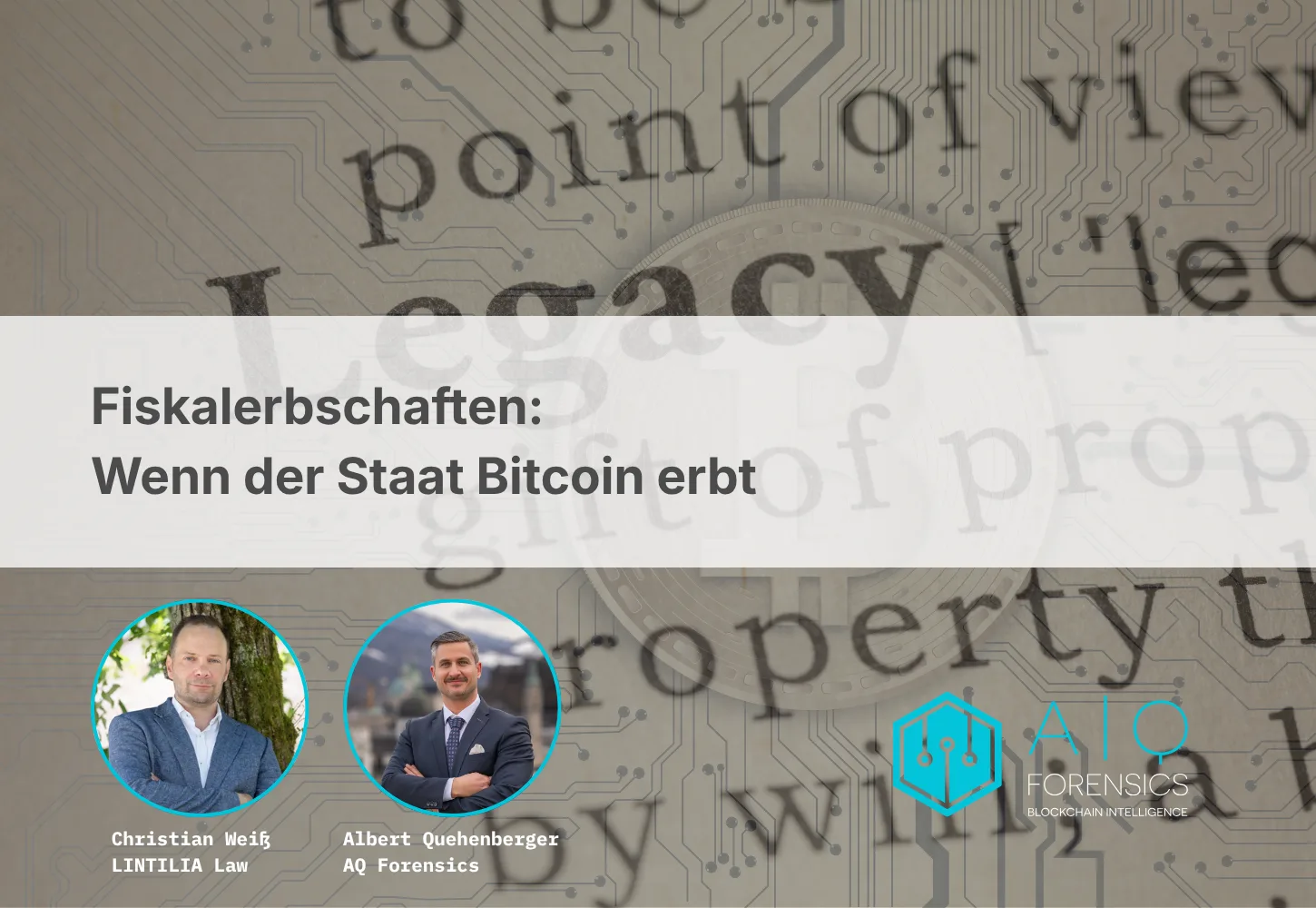
These were exactly the questions we spent an intensive day on at the beginning of September. As part of the Fachseminare von Fürstenberg, attorney Christian Weiß of LINTILIA Law and Albert Quehenberger of AQ Forensics jointly held an in-house seminar for staff responsible at a state authority that regularly handles a large number of escheat estates.
The active participation throughout the entire seminar day showed just how practical this topic has become. Participants brought in their own cases, questioned procedures and discussed concrete problems together.
"Because the classic estate is changing."
Today an estate no longer sits in bank accounts alone
A considerable part of our lives now takes place digitally. A smartphone may contain clues pointing to international payment service providers. An email address can lead to crypto exchanges. An old computer may hold wallet files or access credentials. An inconspicuous sequence of twelve or 24 words can unlock access to substantial crypto assets.
That is precisely why the first challenge is often not only:
How do we secure a digital asset?
but first of all:
How do we even recognise that it exists?
Only then do the further questions begin. Where is the asset held? Who holds it in custody? Is there a central provider? Does a self-custody wallet exist? What holdings existed on the date of death? And were transactions carried out afterwards?
When the state becomes the heir
This development becomes particularly interesting in the case of what are known as escheat estates.
Where no other heirs exist or can be identified, the state itself may become the legal heir.
In such cases the public sector no longer inherits merely property, bank balances or household effects.
It may equally be confronted with crypto exchange accounts, hardware wallets, domains, digital business models, social media accounts or encrypted storage media.
The key insight is therefore:
"Digitalisation does not end with a person's death."
For the bodies charged with settling the estate, reconstructing that person's digital existence often only begins at that point.
At the same time, timing plays a decisive role. Crypto assets can be moved within minutes across wallets, exchanges, swaps or different blockchains. Accounts can be deleted, domains lost and storage media disposed of.
The digital world does not wait for administrative proceedings to conclude.
A bitcoin is not stored „on the USB stick“
Misunderstandings arise quickly, particularly with cryptocurrencies.
A hardware wallet does not simply contain „the bitcoins“. What determines actual control are the cryptographic keys.
This is why a small slip of paper bearing a seed phrase can be worth more to an estate than the computer lying next to it.
What a blockchain reveals – and what it does not
Another focus of our seminar was practical blockchain analysis.
The aim was not to train blockchain forensic examiners in a single day. What mattered far more was an understanding of which statements on-chain data actually permit.
A blockchain can show when a transaction took place, which address sent assets, which address received them and what amount was transferred.
It can also help to identify further wallets, crypto exchanges, swap services or cross-chain movements and to reconstruct historical holdings.
What it does not automatically show, however, is the person behind a wallet.
A wallet address contains no name and does not prove who the beneficial owner was or who actually initiated a transaction.
That is why the following applies in our forensic work:
On-chain data provides facts. Attribution arises from combining them with off-chain information.
It is often only emails, bank records, an exchange's KYC data, smartphones, tax documents or other information that make a reliable attribution possible.
From the presentation straight into the blockchain explorer
Theory alone is not enough for that.
During the seminar, participants therefore received a real transaction hash and analysed their first blockchain transaction themselves.
The task was:
What can we actually see – and what are we perhaps merely interpreting?
Sender address, recipient address, asset, amount, time and block can be established directly.
The identity behind a wallet cannot.
It is precisely this distinction that is decisive for authorities, courts, lawyers and other professionals involved.
Custody or self-custody
For settling an estate it is also essential to know where crypto assets are held.
If they are held at a crypto exchange or another custodian, there is in principle a central point of contact. What matters then includes identifying the account, providing proof of death and of entitlement, and subsequently securing and transferring the assets.
With a self-custody wallet the situation is entirely different.
Here it is the available access that decides.
A seed phrase, private key, hardware wallet, password or an unlocked session can suddenly become the central element of securing an estate.
At the same time, clear organisational processes must be in place: Who may access assets? Who may transfer them? Where are they transferred to? How are the destination address, transaction hash, amount and approvals documented?
Technical possibility and organisational authorisation are two different things.
Digital estates need both law and forensics
That is precisely why combining the two perspectives was so important for this seminar.
Christian Weiß examined the challenges under inheritance and data protection law, together with their many links to copyright and other intangible rights. AQ Forensics contributed expertise in blockchain analysis, digital asset tracing and wallet structures – capabilities also applied in our specialised digital estate and wallet recovery services.
Because a digital estate is not purely an IT matter.
It is an interdisciplinary administrative, legal and forensic matter.
In the end, it is also about far more than Bitcoin.
Banking, payment service providers, cloud storage, domains, digital works, business data, social media and crypto assets have long been part of the reality of our lives.
For authorities and other institutions entrusted with estates, the decisive question is therefore increasingly no longer only:
„Which assets can we see?“
but rather:
„Which assets might exist that we cannot yet see?“
It is at exactly this point that legal experience, structured estate administration and digital forensics meet.
We were particularly pleased that participants contributed actively throughout the entire seminar day and took up the practical blockchain exercise with such interest.
Our thanks go to our hosts, Fachseminare von Fürstenberg, for the organisation and in particular to attorney Christian Weiß and LINTILIA Law for a collaboration that was excellent both professionally and personally. For AQ Forensics this seminar day once again confirms a development we also observe in our daily work:
Digital assets have long since arrived in reality. Now the processes for securing, valuing and settling them must keep pace with that reality.
Crypto transactions demand clarity. We deliver evidence you can trust.
AQ Forensics provides in-depth blockchain analysis, wallet risk assessments, source-of-funds verification, and forensic crypto investigations – independently, transparently, and with legally defensible findings.
Basis of this article
- Among other things, the seminar covered digital estates, escheat law, data protection and the identification, tracing and securing of digital assets.
- The training materials also covered searching for crypto traces on devices and in accounts as well as reconstructing asset movements.
- In the practical part, participants worked through some 20 questions from their escheat law practice together with the speakers.
Über den Autor
Albert Quehenberger is founder and managing director of AQ Forensics GmbH and a specialist in blockchain forensics, cryptocurrency investigations and digital asset analysis. With more than a decade of experience in intelligence, digital investigations and blockchain analysis, he supports companies, banks, lawyers, authorities and private individuals in investigating crypto fraud cases, asset tracing and analysing complex financial flows on public blockchains.
His career includes more than six years in military intelligence, a master's degree from the WU Executive Academy, specialist training for court-appointed experts and training as an election observer to OSCE/ODIHR standards. He is also a member of the expert council of the European Institute for Future Generations (EIFG), a ChangeNOW ambassador and an adviser for Web3 education programmes in Ethiopia.

More AQ ECOSYSTEM articles
- // AQ ECOSYSTEM 001 – AQ Forensics at the Cardano Summit 2025 in Berlin
- // AQ ECOSYSTEM 003 - AQ Forensics train cybercrime investigators in operational blockchain forensics
- // AQ ECOSYSTEM 004 - AQ Forensics expert talk at the United Nations