

Anatomy of a Broker Fraud Involving Cryptocurrencies
Broker fraud with a fake trading platform: the AI arbitrage bot that never existed
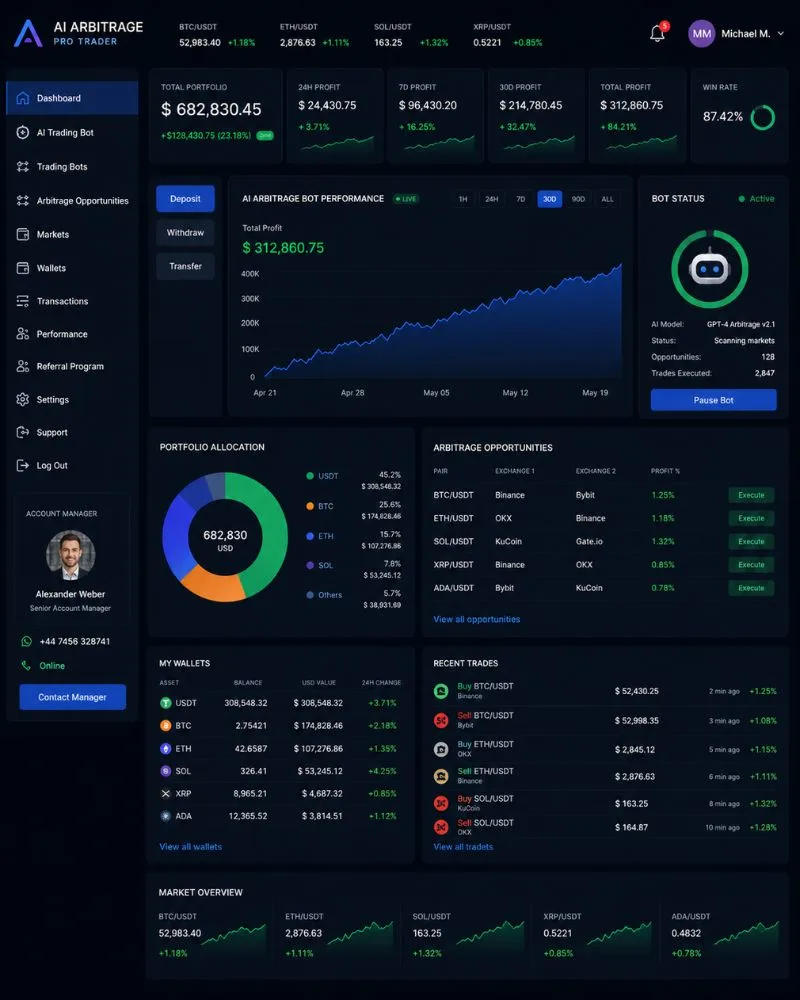
The entry looked professional, modern and technically convincing. A client became aware of a supposedly innovative investment opportunity through a social media advertisement. What was advertised was an AI-based arbitrage trading bot that was to exploit price differences on various markets automatically and thereby generate continuous profits. The platform presented itself as technologically advanced, professionally organised and apparently regulated. What the client did not know at the time: neither the trading bot nor the supposed profits actually existed. The entire trading history was simulated within a manipulated user interface.
Starting position of the case
At the time of registration there was no publicly known warning against the platform.
After filling in a contact form, the client was contacted by a supposed broker. He spoke perfect German, appeared professionally competent and answered questions with assurance.
The trading platform showed:
- account balances
- charts
- bot activity
- arbitrage returns
- trading movements
- profit development
The user interface conveyed the impression of a professional financial service provider.
„In modern broker fraud cases the trading platform is often not the investment – it is the actual instrument of the crime.“
Anyone who has become the victim of crypto fraud should secure digital evidence early. Blockchain forensics, wallet analysis and the documentation of payment flows can create an important basis for further investigations.
If you are unsure whether you are affected, have your case examined discreetly. AQ Forensics supports victims with the analysis of international cryptocurrency fraud cases through blockchain forensics, wallet tracking and structured preservation of evidence.
What is broker fraud with a fake trading platform?
Broker fraud with a fake trading platform is a fraud scheme in which perpetrators simulate a professional trading platform in order to induce investors to make deposits. Contemporary themes are frequently used:
- artificial intelligence
- arbitrage trading
- high-frequency trading
- quantitative strategies
- automated investment models
The profits displayed are frequently entirely manipulated.
Victims see rising account balances and apparently successful trading activity, even though no trading actually takes place.
The platform serves solely to motivate further deposits.
How trust is built systematically
The perpetrators proceeded extremely professionally.
The broker did not push for immediate deposits. Instead, he explained how the system worked in detail and answered questions patiently.
This approach corresponds to a known social engineering pattern regularly observed in investigations.
The aim is to dismantle initial scepticism step by step.
Psychologically, this creates the feeling of making a well-founded investment decision, even though the entire process is already being steered by the perpetrators.
The role of cryptocurrencies in the fraud model
The client was instructed to acquire USDC through a regulated crypto exchange.
He was then to:
- set up his own wallet
- transfer the USDC to that wallet
- forward the assets to the platform
To the client this sequence seemed plausible.
In fact, perpetrators use such intermediate steps deliberately to create the impression that the victim retains control over their assets at all times.
From a forensic point of view, the actual perpetrator address frequently lies only behind this additional wallet layer.
Why the first withdrawal worked
A particularly interesting aspect of the case was the successful test withdrawal.
After the client had initially deposited only 250 USDC, he received 350 USDC back a short time later.
The withdrawal actually worked.
In many broker fraud cases, this moment in particular is regarded as the decisive turning point.
The victim gains the impression:
„I tested the system. It works.“
After that, trust and willingness to invest frequently increase considerably.
Further warning signs of broker fraud with a fake trading platform
Once the deposits had increased significantly, the platform's behaviour changed.
On an attempted withdrawal, an anti-money-laundering check was suddenly announced.
The client would first have to:
- pay an AML fee
- meet compliance requirements
- make a release payment
- transfer additional amounts
This line of argument seems plausible to many investors, since genuine financial institutions are indeed subject to regulatory requirements.
The decisive difference:
Reputable platforms do not demand private cryptocurrency payments in order to release balances.
„As soon as a platform demands additional deposits in order to pay out an existing balance, there is regularly a massive warning sign.“
Blockchain analysis and investigative approaches
From a blockchain forensic point of view, such cases offer numerous starting points.
Particularly relevant are:
- on-ramp via regulated exchanges
- wallet identification
- stablecoin transfers
- wallet clustering
- exchange exposure
- wallet rotation
- layering processes
- pooling of victims' funds
Examining such transaction structures can provide indications of further victims, service providers involved or possible off-ramp structures.
The collapse of the cover story
After the client repeatedly tried to have his balance paid out, the explanations became increasingly contradictory.
Support, technical staff and accounting referred to one another over supposed problems.
Additional payments were supposedly to remove regulatory obstacles.
At the same time, time pressure was built up.
Only when the demands became ever more unrealistic did the client recognise the actual situation and seek professional support.
„The AI bot was never the business model. It was merely the story that was meant to make the flow of money plausible.“
What those affected by broker fraud with a fake trading platform should do
Where cryptocurrency fraud is suspected, AQ Forensics recommends in particular:
- make no further payments
- secure all communication
- document wallet addresses
- save transaction hashes
- archive screenshots of the platform
- secure telephone numbers and email addresses
- document payment sequences chronologically
- commission professional analysis early
Securing digital traces early considerably improves the prospects of further investigations. If you already have a suspicion or have become a victim of crypto fraud, contact AQ Forensics for a professional analysis and the preservation of evidence of your transactions.
Have your case examined without obligation
We analyse your case confidentially and discuss together which measures and next steps are possible.
Closing remarks
This broker fraud with a fake trading platform is a good example of how modern fraud structures use current technology trends for their purposes.
Artificial intelligence, automated trading and cryptocurrencies appear innovative and plausible to many investors. It is precisely this credibility that perpetrators exploit deliberately.
The existence of a professional platform, a competent-seeming broker or a successful test withdrawal is no evidence of the legitimacy of an investment.
What remains decisive is the independent verification of payment routes, trading activity and the actors involved. Blockchain forensic analysis can help to make digital traces visible and create the basis for further investigations.
Über den Autor
Albert Quehenberger leads international investigations in the fields of cryptocurrency fraud, blockchain forensics and digital asset analysis.
His work focuses on the analysis of transnational scam infrastructure, wallet tracking, money laundering processes and the structured investigation of organised crypto crime.

Further cases from the AQ Fraud Intelligence Library
- // AQ FILES 004 – Anatomy of a RIP deal involving cryptocurrencies
- // AQ FILES 006 – Anatomy of a recovery scam after crypto fraud
- // AQ FILES 007 – Anatomy of an international crypto rug pull