

Anatomy of a RIP Deal Involving Cryptocurrencies
How a property transaction became an international fraud case involving cryptocurrencies
When an entrepreneur from southern Germany came across an exclusive villa in Munich's Bogenhausen district on a well-known property portal, a rare opportunity seemed to be on offer. The property was offered well below the usual market price. The seller explained that he had to sell at short notice for family and tax reasons and preferred a discreet transaction outside the conventional marketing process. What initially looked like an extraordinary market opportunity later developed into a professionally staged RIP deal involving cryptocurrencies. In the end, the person affected lost a security deposit of 250,000 USDC.
Starting position of the case
The client was looking for a high-quality residential property in the greater Munich area.
The property on offer came with professional photographs, extensive property documentation, floor plans, energy performance certificates and further documents that looked authentic at first glance.
Particularly convincing was the plausibility of the story. The seller described comprehensible reasons for the quick sale and answered questions in detail.
From the client's point of view there were no obvious indications of fraud at that time.
„The most effective fraud models do not look unrealistic. They look plausible.“
Anyone who has become the victim of crypto fraud should secure digital evidence as early as possible. Blockchain forensics, wallet tracking and structured preservation of evidence can create an important basis for further investigative measures.
If you are unsure whether you are affected, have your case examined discreetly. AQ Forensics supports victims with the analysis of international cryptocurrency fraud cases through blockchain forensics, wallet tracking and structured preservation of evidence.
What is a RIP deal involving cryptocurrencies?
A RIP deal involving cryptocurrencies is a professional fraud scheme in which perpetrators create the impression of a high-value transaction without ever intending to carry out the actual deal.
Typical areas of use are:
- property transactions
- luxury vehicles
- art dealing
- precious metals
- company shareholdings
The aim is to induce the victim to make a large advance payment, security deposit or escrow payment.
Unlike classic investment scams, RIP deals are frequently supported by real meetings, extensive documentation and elaborate staging. This makes them particularly credible.
How perpetrators create trust and exclusivity
After the initial contact, communication moved to WhatsApp.
The seller became increasingly personal in his manner. Further people also appeared in the communication process, including supposed legal advisers, assistants and property agents.
This division of roles conveyed professionalism and legitimacy.
At the same time it was suggested that several prospective buyers existed. The client, however, had been given priority because of his respectability.
This created a mixture of exclusivity and time pressure that made a critical examination of the situation increasingly difficult.
Why in-person meetings guarantee no security
A particularly notable aspect of this case was the in-person meeting in the Balkans.
There the client met several of those involved, viewed business premises and discussed contract documents.
For many victims, in-person meetings are a decisive factor of trust.
From a forensic point of view, however, it regularly emerges that professional perpetrator groups deliberately exploit precisely this effect. The physical encounter frequently serves to dispel any last doubts and increase the later willingness to pay.
The role of stablecoins in the fraud scheme
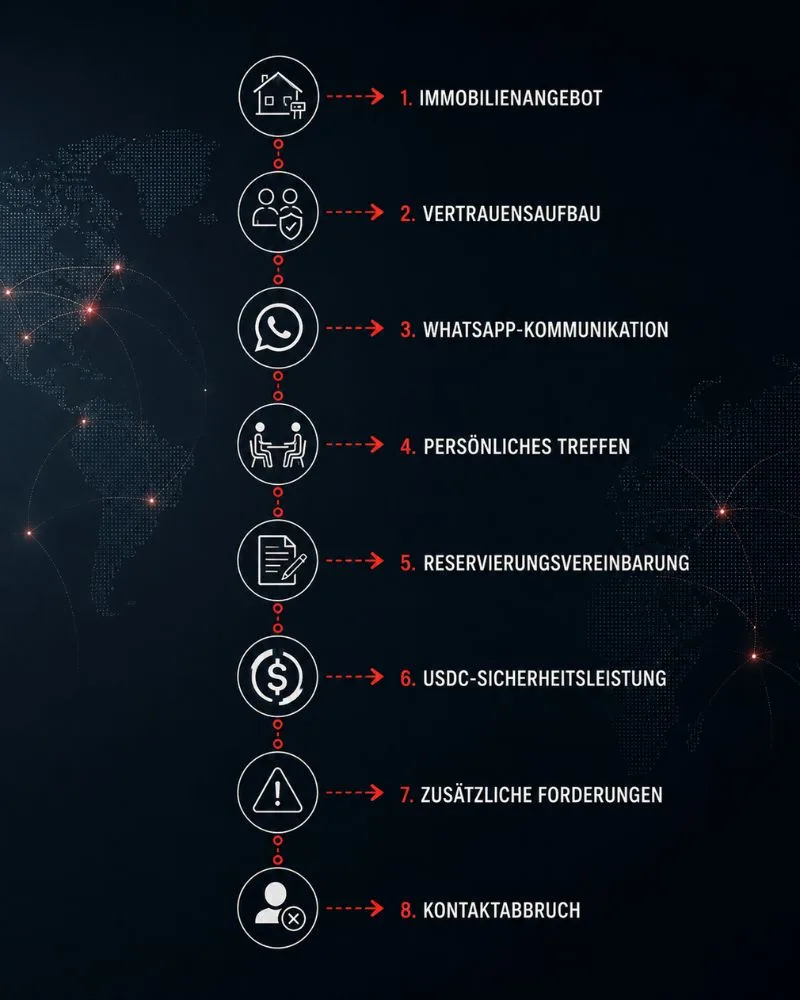
The security deposit demanded came to 250,000 USDC.
Stablecoins such as USDC or USDT are frequently used in international fraud cases because they combine the advantages of classic cryptocurrencies with a comparatively stable price structure.
For perpetrators this brings several advantages:
- fast international transferability
- no conventional chargebacks
- easy forwarding through several wallets
- use of different jurisdictions
- high mobility of the assets
In high-volume fraud cases in particular, stablecoins therefore play a central role.
Further warning signs of a RIP deal involving cryptocurrencies
Once the security deposit had been transferred, the behaviour of those involved changed.
Suddenly new problems were communicated:
- supposed tax questions
- additional security
- international reporting obligations
- further payment demands
This pattern is typical of many professional fraud models.
Once initial payments have been made, perpetrators frequently try to obtain additional funds.
„The fraud rarely ends with the first payment. Frequently that is when the second phase of exploitation begins.“
Blockchain analysis and investigative approaches
From the perspective of blockchain forensics, such cases open up important investigative approaches.
The focus is in particular on:
- analysis of the recipient wallets
- tracing stablecoin transfers
- identification of wallet clusters
- examination of layering structures
- analysis of possible exchange exposures
- identification of further victim flows
Even where perpetrators rotate wallets or forward assets through several stations, digital traces frequently arise in the process.
The collapse of the supposed property transaction
After the client refused further payments, communication broke off step by step.
WhatsApp accounts were deactivated.
Email addresses no longer responded.
Websites disappeared.
Later enquiries showed that the property offered did in fact exist, but belonged to an uninvolved third party.
A real sale had never taken place.
„The actual object of the transaction was never the perpetrators' goal. It was merely the cover story for accessing the victim's assets.“
What those affected by a RIP deal involving cryptocurrencies should do
Where cryptocurrency fraud is suspected, AQ Forensics recommends in particular:
- make no further payments
- secure all communication
- document wallet addresses
- save transaction hashes
- archive contracts
- secure travel documentation
- commission a professional analysis by a blockchain forensics company early
Securing digital traces early considerably improves the prospects of further investigations. If you already have a suspicion or have become a victim of crypto fraud, contact AQ Forensics for a professional analysis and the preservation of evidence of your transactions.
Have your case examined without obligation
We analyse your case confidentially and discuss together which measures and next steps are possible.
Closing remarks
This RIP deal involving cryptocurrencies shows how professionally organised modern fraud structures are today.
In-person meetings, high-quality documents and real objects of sale create a high degree of credibility. It is precisely this combination of the physical world and digital payment processing that makes international RIP deals so dangerous.
The existence of a real object or an in-person meeting never replaces the independent verification of the people involved, the documents and the payment routes.
Blockchain forensic analysis can help to document payment flows in a comprehensible way and create the basis for further investigative measures.
Über den Autor
Albert Quehenberger leads international investigations in the fields of cryptocurrency fraud, blockchain forensics and digital asset analysis.
His work focuses on the analysis of transnational scam infrastructure, wallet tracking, money laundering processes and the structured investigation of organised crypto crime.

Further cases from the AQ Fraud Intelligence Library
- // AQ FILES 003 – Anatomy of an international crypto Ponzi scheme
- // AQ FILES 005 – Anatomy of a broker fraud involving cryptocurrencies
- // AQ FILES 006 – Anatomy of a recovery scam after crypto fraud