AQ Forensics and Experts Train Cybercrime Investigators in Operational Blockchain Forensics
A joint specialist training course gave a police cybercrime unit practical knowledge of blockchain investigations, smart contracts, money laundering patterns and digital evidence preservation.
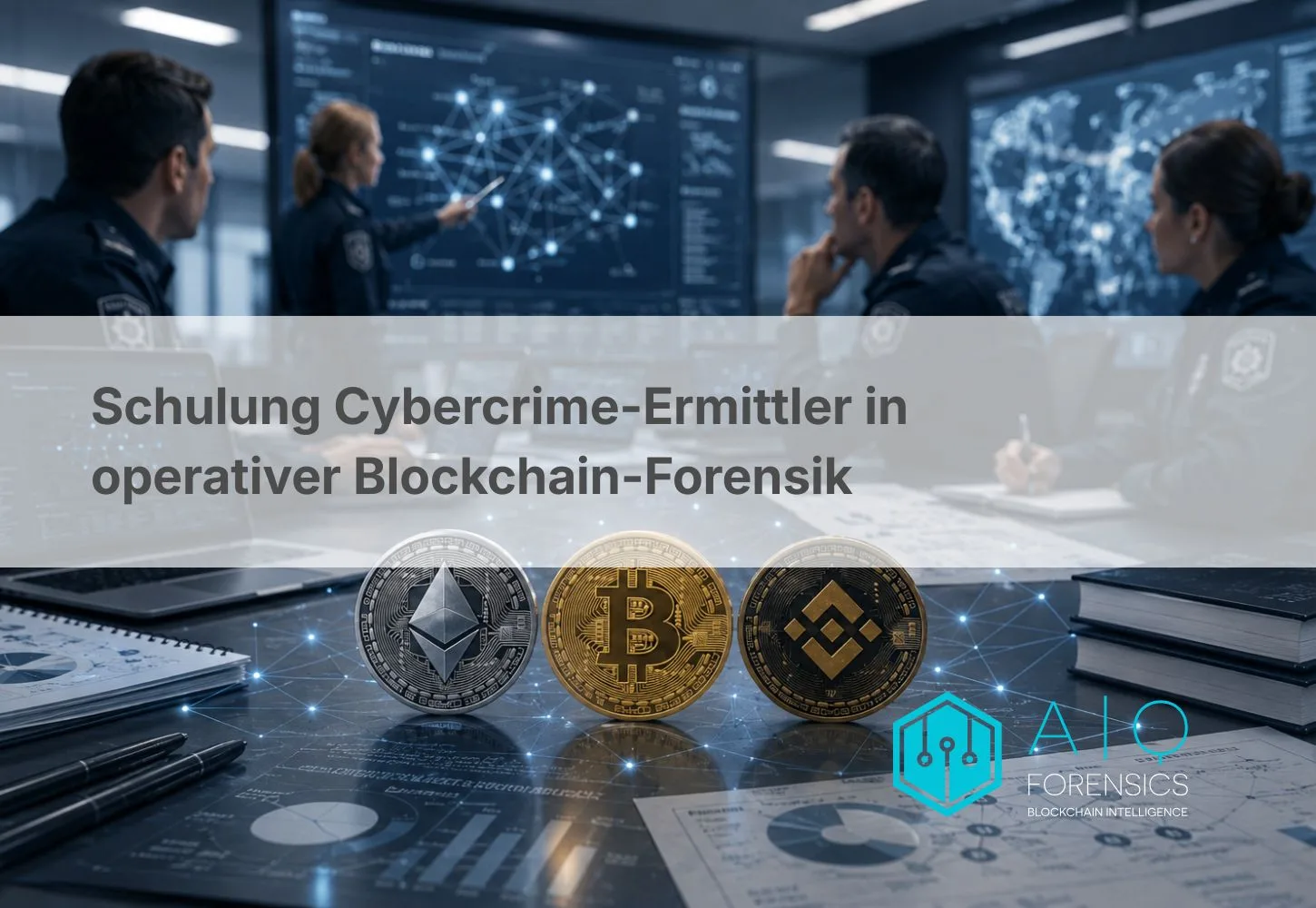
The importance of cryptocurrencies in cybercrime investigations has been increasing steadily for years. Fraud cases, wallet drainers, investment scams, money laundering proceedings and the abusive use of decentralised applications increasingly confront investigative authorities with technical and operational challenges. Against this background, a joint specialist training course was held for a police cybercrime unit. Together with specialised experts, AQ Forensics conveyed practical knowledge of operational blockchain forensics, smart contract analysis, money laundering patterns and digital evidence preservation. The focus was on the question of how modern crypto investigations can be conducted efficiently, comprehensibly and robustly, and which skills investigators need in order to assess complex blockchain matters correctly.
Background to the training
Crypto-related offences are increasingly developing into complex investigations with an international dimension. Public blockchains do generate extensive data traces, but interpreting them professionally requires technical understanding, a methodical approach and practical experience.
Wallet addresses show movements of digital assets, but they do not automatically answer the decisive investigative questions. Which wallets are connected to one another? Which assets were transferred where? What role did smart contracts, decentralised applications or centralised platforms play? And which traces are actually relevant for the further handling of the case?
The training was developed to convey precisely this understanding to investigators and to view blockchain forensics not as a mere software application, but as an operational investigative discipline.
Practice-oriented focus on modern crypto investigations
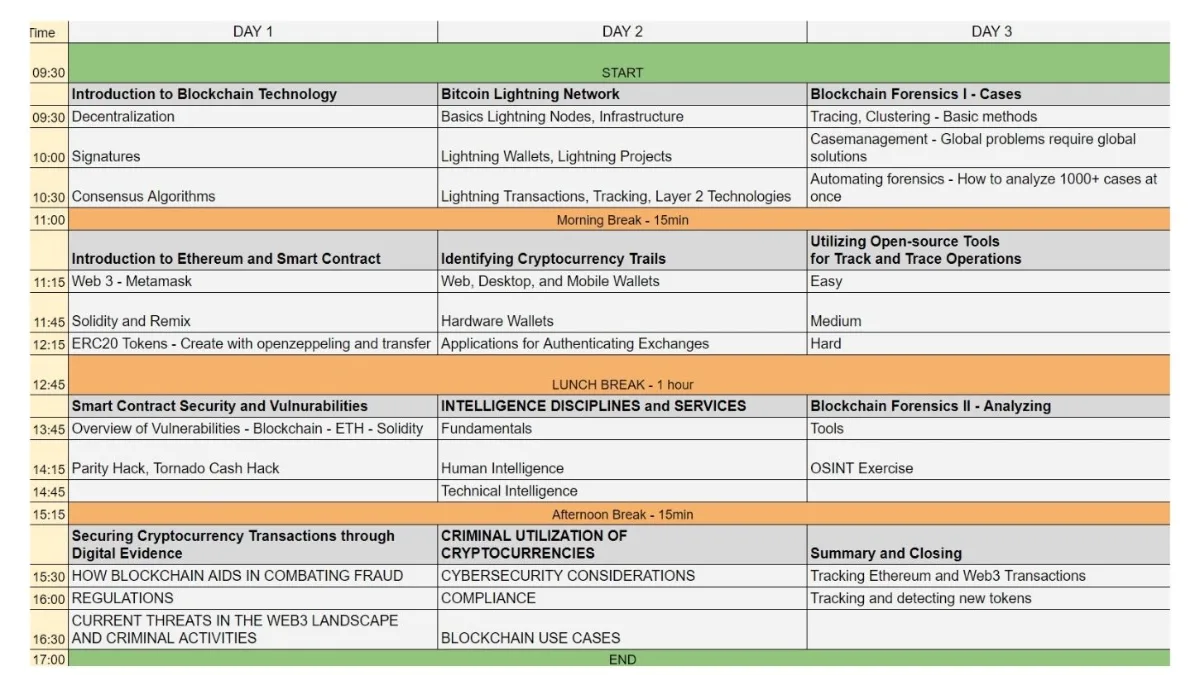
The emphasis of the training was on practical case handling and the requirements that arise in everyday investigative work.
The topics covered included:
- analysis of wallet structures and transaction histories
- smart contract interactions and their significance for investigations
- identification of typical money laundering patterns
- chain hopping, bridges
- digital evidence preservation and documentation
- development of robust investigative approaches
Particular attention was given to the question of how a comprehensible situational picture emerges from individual blockchain data points. A single transaction rarely provides sufficient context. Only the structured analysis of wallet relationships, smart contract interactions and transaction patterns makes a well-founded assessment of complex matters possible.
„Blockchain forensics begins where individual data points turn into a robust investigative approach.“
The experts involved
The training brought together different specialist areas of modern blockchain and cybercrime investigation.
Patrick Fodor contributed his experience in smart contract security, operational on-chain analysis and the investigation of technical attack scenarios. One focus was on practical exercises on the analysis of exploits, smart contract interactions and splitting and merging patterns in complex flows of funds.
Thomas Niedermayer Thomas Niedermayer, data scientist at Iknaio Cryptoasset Analytics and contributor to GraphSense, conveyed data-driven approaches to analysing complex blockchain networks and large-scale transaction structures.
Markus Angermann , managing director of Angermann IT-Services and lecturer in smart contract development at St. Pölten University of Applied Sciences, added the technical perspective on Web3 applications, smart contract risks and decentralised systems.
Albert Quehenberger , founder and CEO of AQ Forensics, contributed his experience from international blockchain investigations, asset tracing procedures and the forensic analysis of complex cryptocurrency cases.
Why such training courses are becoming increasingly important
The technical complexity of modern crypto cases continues to grow. Perpetrators use various blockchains, smart contracts, cross-chain bridges, decentralised protocols and international service providers to move assets or obscure their origin.
At the same time, the requirements for documentation, preservation of evidence and professional traceability are rising. Investigative authorities therefore need not only access to data, but above all the ability to interpret that data correctly and turn it into robust investigative approaches.
The role of AQ Forensics
AQ Forensics supports companies, law firms, financial service providers, authorities and victims with the analysis of complex blockchain matters and digital asset movements.
In this training, the emphasis was on transferring practical experience from real investigative cases. The aim was to convey technical connections in an understandable way and to help participants develop a structured understanding of investigations in the blockchain environment. The event made clear that modern blockchain forensics goes far beyond the use of individual analysis platforms. What is decisive is a methodical approach, technical assessment and comprehensible documentation.
Assessment and outlook
The joint training of a police cybercrime unit shows the growing importance of operational blockchain forensics in the professional investigative environment.
As digital assets spread further, blockchain data is becoming a relevant part of evidence and case analysis in more and more proceedings. At the same time, the need for practical training, technical understanding and interdisciplinary cooperation is growing.
The event underlines that blockchain forensics can no longer be regarded as a niche topic today. It is increasingly developing into a fixed component of modern cybercrime investigations and digital financial analysis.
Interested in specialist training, a workshop or a talk on blockchain forensics and cryptocurrency investigations?
AQ Forensics supports authorities, companies and institutions with training courses, workshops, blockchain analysis and operational expertise.
Über den Autor
Albert Quehenberger is founder and managing director of AQ Forensics GmbH and a specialist in blockchain forensics, cryptocurrency investigations and digital asset analysis. With more than a decade of experience in intelligence, digital investigations and blockchain analysis, he supports companies, banks, lawyers, authorities and private individuals in investigating crypto fraud cases, asset tracing and analysing complex financial flows on public blockchains.
His career includes more than six years in military intelligence, a master's degree from the WU Executive Academy, specialist training for court-appointed experts and training as an election observer to OSCE/ODIHR standards. He is also a member of the expert council of the European Institute for Future Generations (EIFG), a ChangeNOW ambassador and an adviser for Web3 education programmes in Ethiopia.
Further analyses & case studies
- // AQ INSIGHTS 001 – Reconstructing cross-chain swaps
- // AQ FILES 008 – Anatomy of a wallet hack with a wallet drainer
- // AQ ECOSYSTEM 001 – AQ Forensics at the Cardano Summit 2025 in Berlin