

Crypto Mixers in Blockchain Forensics.
How blockchain forensic specialists analyse flows of funds despite mixing services and reduce the anonymity set
Crypto mixers are among the best-known tools for increasing financial privacy on public blockchains. In connection with cryptocurrency fraud, ransomware, money laundering, sanctions evasion and international investigations in particular, mixing services are regularly regarded as a potential obstacle to tracing digital assets. From this, the assumption frequently arises: „Once cryptocurrencies pass through a mixer, any possibility of tracing them ends.“ That statement falls short, however. Mixing services can make the direct assignment between deposits and withdrawals considerably more difficult. They do not, however, automatically preclude every investigative approach.
Modern blockchain forensics therefore does not attempt to break the underlying cryptography of privacy protocols. Instead, statistical, temporal, structural and behavioural characteristics are analysed in order to reduce the number of possible assignments systematically. To understand why this is possible, it is first necessary to look at how modern crypto mixers work.
What are crypto mixers?
Crypto mixers, often also referred to as mixing services or privacy protocols, aim to reduce the direct traceability of blockchain transactions.
While public blockchains document all transactions transparently, mixers attempt to break the direct link between sender and recipient.
The best-known example of this is Tornado Cash on the Ethereum blockchain. Tornado Cash is particularly well suited as a case example because its technical operation has been publicly documented and analysed in academic work. The underlying principles are, however, also found in other mixing services and privacy infrastructures.
Why crypto mixers matter for investigations
For law enforcement agencies, financial institutions, compliance departments and blockchain forensic specialists, crypto mixers present a particular challenge. While conventional blockchain analysis is based on transparent transaction chains, mixing services deliberately set out to reduce precisely that transparency.
The central question is therefore not: „Can a mixer be cracked?“ but: „Which information remains analysable despite the mixing?“
This is exactly where modern blockchain forensics comes in. The aim is not to break privacy protocols. Rather, additional data points are used to narrow down possible connections between deposits and withdrawals and to analyse downstream flows of funds further.
How modern mixing services work
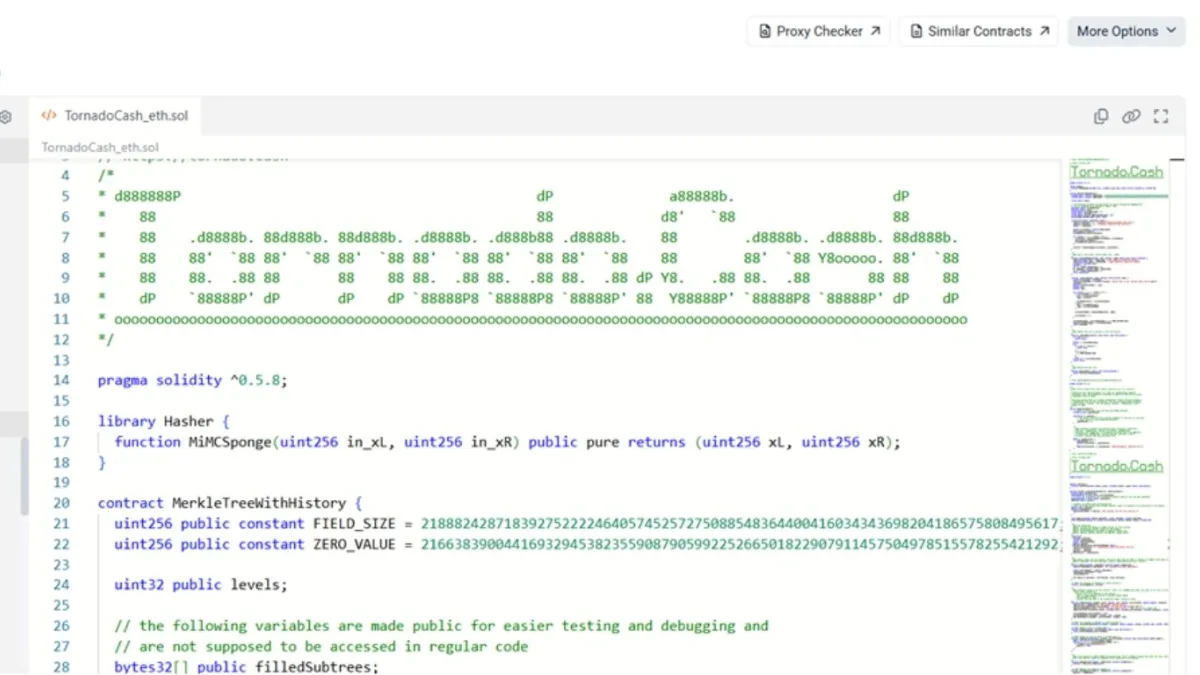
The example of Tornado Cash illustrates the basic architecture of modern mixing protocols particularly well. Tornado Cash is based on smart contracts, Merkle trees and zero-knowledge proofs.
The aim of the protocol is to obscure the direct link between a deposit address and a later withdrawal address.
In simplified terms:
- Wallet A
- ↓
- Tornado Cash
- ↓
- Wallet B
Whereas every movement in an ordinary blockchain transaction is directly traceable, Tornado Cash severs this link using cryptographic methods.
Step 1: creating a commitment
Before the deposit, the user generates two random values locally:
- nullifier
- secret
These values never leave the user's device. From both values, a cryptographic commitment value is then generated, which is later stored in the smart contract.
The smart contract stores only the commitment. The underlying secret values remain unknown.
Step 2: storage in the Merkle tree
All commitments are stored within a Merkle tree. In simplified terms:
- Root
- ↓
- Commitment A
- Commitment B
Every new deposit adds a further commitment to the tree. The resulting Merkle root represents the current state of all deposits within the pool.
The decisive advantage: it can later be proved that a particular commitment is contained in the tree without revealing which specific commitment was used.
Step 3: withdrawal by means of a zero-knowledge proof
If a user wishes to withdraw their deposit again, they generate a zk-SNARK proof locally.
This proof simultaneously confirms:
- a valid deposit exists
- the associated commitment is in the Merkle tree
- the deposit has not yet been spent
The proof does not, however, reveal:
- which deposit was used
- which address originally deposited
- which entry in the Merkle tree is concerned
The smart contract only checks whether the proof is mathematically correct.
This produces the central privacy property of Tornado Cash: the existence of a deposit is proved without disclosing its identity.
Step 4: protection against double withdrawals
So that the same deposit cannot be withdrawn more than once, Tornado Cash uses what is known as a nullifier hash. This value is published at the time of withdrawal. The smart contract stores all nullifier hashes already used.
If someone attempts to spend the same deposit again, the contract recognises the nullifier already used and rejects the transaction.
This prevents double spending without disclosing the original deposit.
What Tornado Cash actually protects
A frequent misconception is to describe Tornado Cash as „untraceable“.
What is technically correct is: Tornado Cash protects the direct assignment between deposit and withdrawal within the same pool.
The protocol does not, however, automatically protect:
- statistical anomalies
- downstream flows of funds
- external investigative information
- publicly available additional data
- the totality of all activity of an actor
Blockchain forensics therefore examines not only the mixer itself, but the entire context of a flow of funds.
The concept of the anonymity set
The most important term in connection with modern crypto mixers is the anonymity set.
Suppose there are 1,000 deposits within a 10 ETH pool.
If a withdrawal of 10 ETH is later observed, it could theoretically belong to any of those deposits.
- 1,000 possible deposits
- ↓
- 1 withdrawal
The task of blockchain forensics is therefore not to restore a cryptographic link. Rather, the attempt is made to reduce the number of plausible candidates through additional information.
- 1,000 possible deposits
- ↓
- Heuristics
- ↓
- 150 candidates
- ↓
- further analysis
- ↓
- 25 candidates
This approach is referred to as reducing the anonymity set.
Practical relevance from real investigations
The approaches described in this article are not based exclusively on academic literature.
AQ Forensics has been involved in several complex investigations in which assets were demonstrably transferred via swap service providers, cross-chain infrastructures and mixing services. In individual cases, Tornado Cash and comparable privacy protocols were also used.
One particularly extensive case concerned the movement of around 300 BTC, which were first converted into ETH via a swap service provider. The assets were then moved through several wallet structures and partly obscured by further swap and cross-chain transactions before finally interacting with Tornado Cash.
To a superficial analysis, the trail could have appeared to be an end point at several places: first at the swap service provider, later at bridge or router addresses, and finally at the mixing process itself.
In fact, however, these were merely technical transitions within a larger transaction network.
AQ Forensics first reconstructed the original Bitcoin transactions and then analysed the conversion into ether. After that, the Ethereum transactions, smart contract interactions, swap operations and cross-chain movements were examined.
With cross-chain investigations in particular, it regularly becomes apparent that a trail does not automatically end when assets are transferred to a bridge or a swap contract. In many cases the underlying transactions contain additional information that can make it possible to reconstruct the further movements of assets.
In the case at hand, the withdrawals after the mixing were not assessed on the basis of a single analysis platform. Instead, several blockchain analysis tools as well as different methodological approaches were used.
All material findings were verified redundantly in order to exclude, as far as possible, misattributions, spurious correlations and technical errors of interpretation.
The analysis showed that while swaps, cross-chain transfers and mixing services can make tracing assets considerably more difficult, they do not necessarily represent the end of a forensic investigation.
For reasons of confidentiality, the underlying case files cannot be published.
The experience from these proceedings does, however, confirm a central insight of modern blockchain forensics: the challenge does not lie in breaking Tornado Cash cryptographically, but in reducing the anonymity set as far as possible through additional information, technical analysis and the examination of downstream flows of funds.
Method 1: analysis of characteristic deposit patterns
Tornado Cash works with standardised pool sizes. Historically there were pools for, among others:
- 0.1 ETH
- 1 ETH
- 10 ETH
- 100 ETH
This gives rise to characteristic patterns at certain transaction sizes.
Such a pattern does not prove a connection, but it can reduce the number of plausible candidates within an anonymity set.
Method 2: temporal analysis
Alongside the amounts, the temporal structure of deposits and withdrawals plays an important role. This does not assert that a particular deposit is automatically connected with a particular withdrawal. Rather, statistical differences between random and potentially connected transaction patterns are examined. Such observations do not constitute proof, but they can feed into an overall assessment as an additional factor.
Method 3: statistical reduction of the anonymity set
The core of modern mixer analysis frequently lies not in searching for a direct link, but in assessing probabilities.
The factors considered can include:
- pool size
- number of simultaneous deposits
- number of simultaneous withdrawals
- activity level of a pool
- temporal distributions
- statistical anomalies within larger data sets
The aim is not to identify a specific deposit. The aim is to reduce the number of possible candidates step by step.
Analysis of the flows of funds after the mixer
In real investigations, the emphasis is frequently not on the mixing service itself.
Often much more important is the question: „What happens after the withdrawal?“
As soon as assets are moved again, new data points arise.
These can be, for example:
- further on-chain transactions
- smart contract interactions
- cross-chain movements
- deposits at service providers
- other publicly visible flows of funds
The actual investigative work therefore frequently begins only after the assets leave the mixer.
Those who suspect they have become victims of cryptocurrency fraud will find further information and recommended first steps on the page Crypto fraud emergency help.
Limits of blockchain forensics with crypto mixers
A serious look at Tornado Cash also has to take account of the limits of the analysis. In certain cases, a withdrawal cannot be assigned to a specific deposit with sufficient certainty. Blockchain forensics therefore does not deliver an unambiguous identification in every case.
The evidential value of an analysis always depends on the available data and the specific circumstances.
Lassen Sie Ihren Fall unverbindlich prüfen
AQ Forensics supports in handling complex crypto incidents – from blockchain forensics and operational incident response to securing and recovering digital assets.
Conclusion
Tornado Cash is among the most technically advanced privacy protocols in the blockchain ecosystem. The zero-knowledge proofs it uses deliberately prevent the direct assignment between deposit and withdrawal, and thus fulfil their intended purpose.
Modern blockchain forensics therefore does not attempt to circumvent this cryptographic protective function. Instead, it concentrates on reducing the anonymity set through the analysis of transaction patterns, temporal correlations and statistical anomalies.
Experience from real AQ Forensics investigations shows that the combination of on-chain analysis, swap reconstruction, cross-chain investigation and the examination of downstream transaction patterns in particular can regularly provide additional investigative approaches – even where assets have previously been transferred through mixing services.
The central insight is: „Crypto mixers do not make investigations impossible. They merely change the nature of the analysis.“
For blockchain forensic specialists, the trail therefore does not end at the mixer – it merely becomes more complex and requires a considerably broader investigative approach than simply looking at individual transactions.
Über den Autor
Albert Quehenberger is founder and managing director of AQ Forensics GmbH and a specialist in blockchain forensics, cryptocurrency investigations and digital asset analysis. With more than a decade of experience in intelligence, digital investigations and blockchain analysis, he supports companies, banks, lawyers, authorities and private individuals in investigating crypto fraud cases, asset tracing and analysing complex financial flows on public blockchains.
His career includes more than six years in military intelligence, a master's degree from the WU Executive Academy, specialist training for court-appointed experts and training as an election observer to OSCE/ODIHR standards. He is also a member of the expert council of the European Institute for Future Generations (EIFG), a ChangeNOW ambassador and an adviser for Web3 education programmes in Ethiopia.

Further analyses & case studies
- // AQ INSIGHTS 001 – Reconstructing Cross-Chain Swaps
- // AQ CASES 002 – Asset recovery in practice
- // AQ FILES 009 – Anatomy of a fraud with stolen cryptocurrencies
Sources & further information
- Tornado Cash Documentation – Core Deposit Circuit
- Tornado Cash Documentation – Tornado Trees
- Tornado Cash Circuits Documentation
- Tornado Cash Whitepaper
- Wu et al. (2022): Tutela: An Open-Source Tool for Assessing User Privacy on Ethereum and Tornado Cash
- Cristodaro et al. (2025): Clustering Deposit and Withdrawal Activity in Tornado Cash. A Cross-Chain Analysis
- RareSkills – How Tornado Cash Works
- Tornado Cash Reference Manual for Developers