
Reconstructing Cross-Chain Swaps: How Blockchain Forensic Specialists Follow Crypto Transfers Across Bridges
Reconstructing Cross-Chain Swaps: How Blockchain Forensic Specialists Follow Crypto Transfers Across Bridges
In many blockchain investigations, an apparent end point arises as soon as assets are transferred to a bridge or swap service provider. The transaction shows a known service. The analysis tool identifies a platform. The visible token transfer ends at an address labelled as a bridge, router or wallet service. For many investigators, that is where it stops. From a forensic point of view, however, this is frequently the point at which a deeper analysis begins. Cross-chain transactions often contain more information than is visible in the standard view of an on-chain analysis platform.
„A bridge is not automatically the end of the trail. Often it is only the transition into a different technical representation.“
In brief: how can cross-chain swaps be reconstructed?
Cross-chain swaps can be reconstructed by analysing the original transaction on the source chain, evaluating the event logs of the bridge or swap contract and identifying the destination chain via parameters such as dstChainId. The recipient address and destination token then have to be converted, where necessary, into the address format of the destination chain and matched against transactions on the appropriate destination chain explorer. In the example examined, Etherscan shows not only a USDT transfer to Bitget Wallet: Swap Bridge, but also, in the logs, the destination chain TRON, the destination address and the destination token.
What is a bridge?
A blockchain bridge is a technical service that moves assets between different blockchains.
This does not necessarily involve a simple transfer from wallet A to wallet B. Depending on the architecture, assets are deposited into a contract on the source chain, settled in a liquidity pool, routed via a solver or paid out on the destination chain in a corresponding asset.
For users, bridges are a convenience. For investigators they are analytical transition points.
Starting position of the example transaction
The Ethereum transaction examined is:
- 0x231b6bacc6bb15c9df7e8fc6ec8ecdd08ffe33900599b23658243cfd94073c98
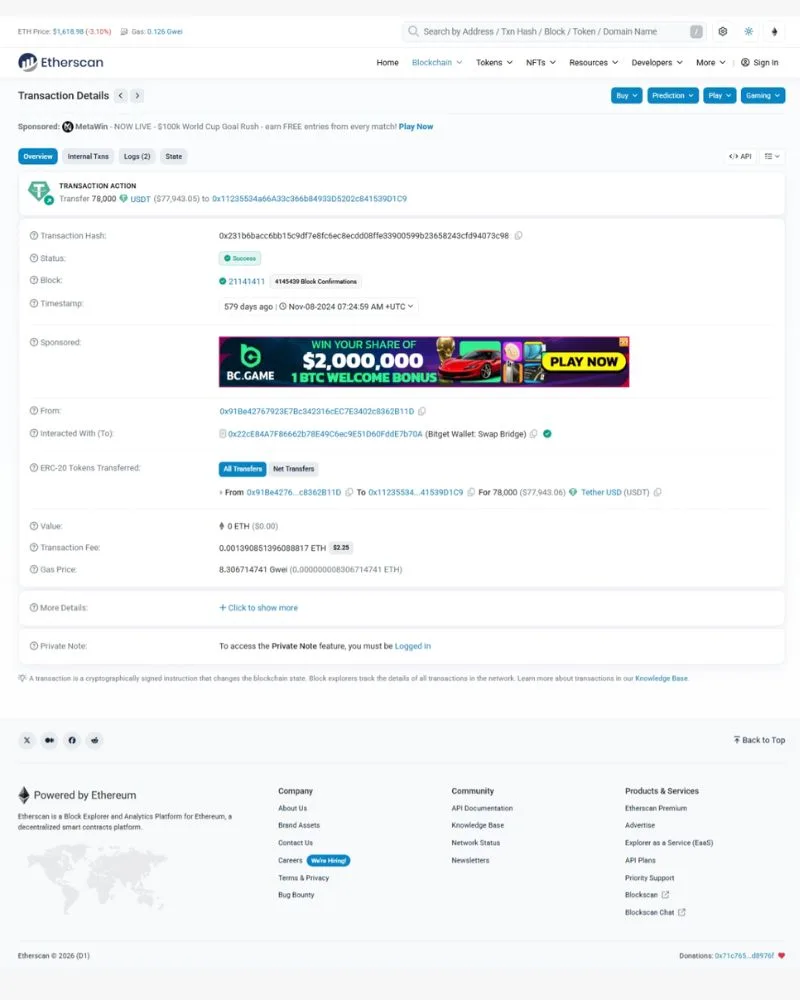
In the ordinary transaction view it is visible that 78,000 USDT were transferred.
The sender was:
- 0x91Be42767923E7Bc342316cEC7E3402c8362B11D
The interaction was with:
- 0x22cE84A7F86662b78E49C6ec9E51D60FddE7b70A
This contract is labelled on Etherscan as Bitget Wallet: Swap Bridge.
To a superficial analysis, the case therefore looks clear at first: USDT were transferred to a bridge service.
But this representation is incomplete.
Why the standard view is not enough
The standard view of an explorer or analysis tool frequently shows only the most obvious part of a transaction.
In the example, that is the ERC-20 transfer of USDT.
What is not immediately visible there as an investigative route is the bridge-specific additional information. That is held in the transaction receipt event logs.
These document technical events that a smart contract emits during execution. For ordinary users these logs are often irrelevant. For blockchain forensic specialists they can decide a case.
„Anyone who looks only at the token transfer sees the entry into the bridge. Anyone who evaluates the logs sees the possible exit on the destination chain.“
The decisive clue in the logs
In the logs of the example transaction there is an event designated BKBridge.
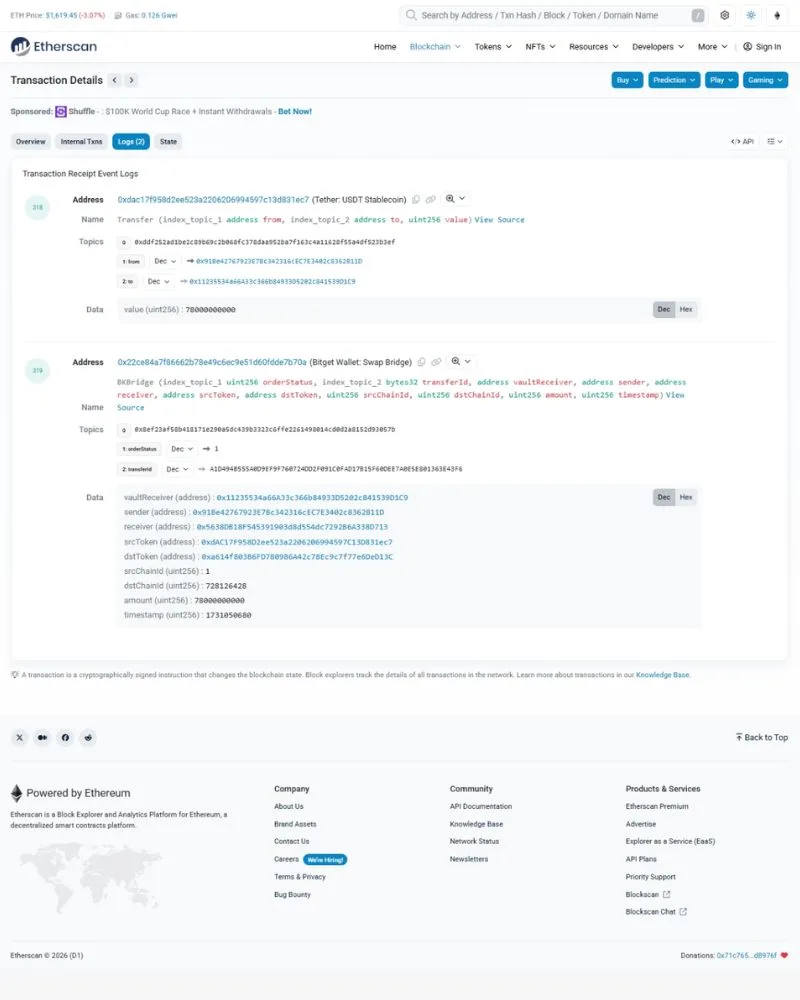
This event contains, among others, the following fields:
- vaultReceiver
- sender
- receiver
- srcToken
- dstToken
- srcChainId
- dstChainId
- amount
- timestamp
These fields describe not only that assets were transferred to a bridge contract. They contain indications of where the assets were to be forwarded as part of the cross-chain operation.
Particularly relevant are:
- sender: 0x91Be42767923E7Bc342316cEC7E3402c8362B11D
- receiver: 0x5638DB18F545391903d8d554dc7292B6A338D713
- srcToken: 0xdAC17F958D2ee523a2206206994597C13D831ec7
- dstToken: 0xa614f803B6FD780986A42c78Ec9c7f77e6DeD13C
- srcChainId: 1
- dstChainId: 728126428
- amount: 78000000000
Since USDT on Ethereum uses six decimal places, this value corresponds to 78,000 USDT.
Why the destination address has to be converted
A frequent stumbling block in cross-chain analysis is the address format.
In practice, TRON addresses are usually shown in Base58Check format and frequently begin with T.
In the logs, however, the destination address may appear in a hexadecimal format that looks like an Ethereum address:
- 0x5638DB18F545391903d8d554dc7292B6A338D713
For further analysis on TRON, this address has to be converted into the TRON-compatible format.
In the example this yields:
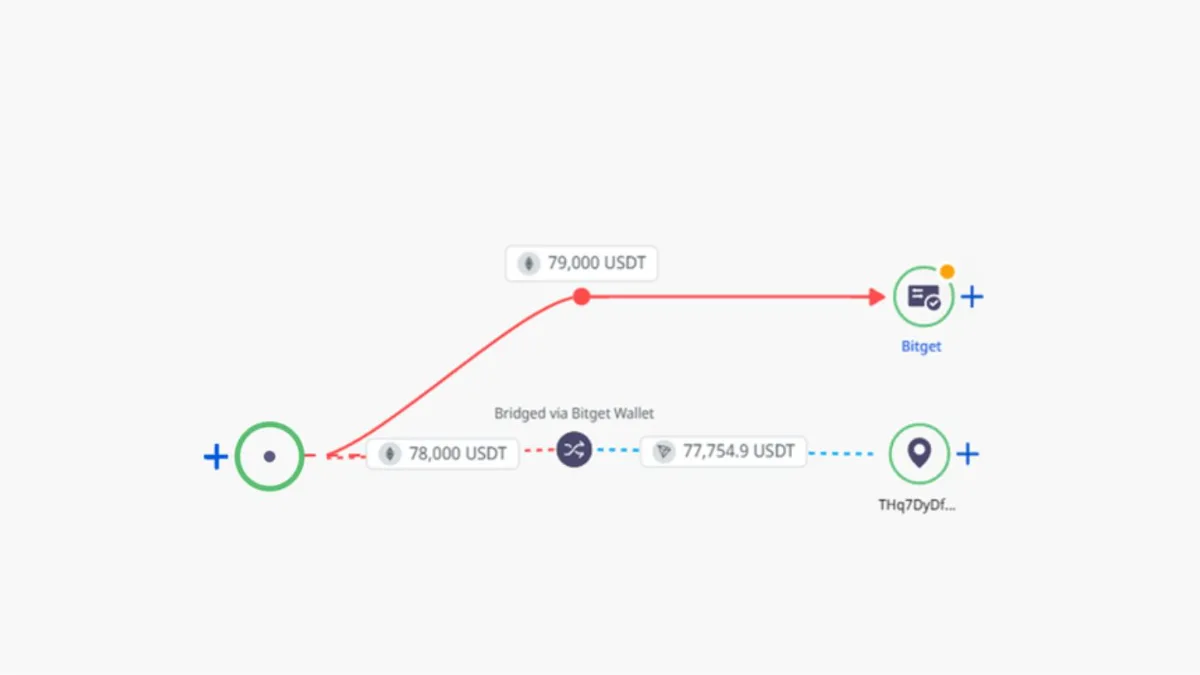
- THq7DyDfkuS1hvwjyF6bK6zeqxUNZ7ykcy
The destination token can be converted too:
- 0xa614f803B6FD780986A42c78Ec9c7f77e6DeD13C
corresponds on TRON to:
- TR7NHqjeKQxGTCi8q8ZY4pL8otSzgjLj6t
This address is known as the USDT token address on TRON.
An apparent end point thus becomes an analysable transaction path again.
Why investigators sometimes have to leave their main tool
Professional analysis platforms are indispensable. They help with wallet clustering, risk assessment, exchange identification, visualisation and case structuring.
Even so, there are situations in which an analyst has to leave the main tool for a moment.
That is the case in particular where:
- a bridge protocol is not fully supported
- a cross-chain conversion is not displayed automatically
- non-EVM chains are involved
- event logs have to be evaluated manually
- special address conversions are required
- explorer data, documentation or OSINT sources are needed in addition
That is not a contradiction of tool use. It is operational blockchain forensics.
„Tools deliver visibility. Forensic analysis arises where data is assessed correctly.“
Why „bubbling“ is no substitute for forensic analysis
In practice, a pattern known as „bubbling“ can frequently be observed among inexperienced analysts.
What is meant is the purely linear following of transactions until an apparent end point is reached. Frequently that is a labelled exchange, a bridge service, a swap router or a known service address.
Transactions are clicked through graphically, but not analysed sufficiently.
From a forensic point of view, bubbling is problematic because it creates the impression of an analysis without actually evaluating the relevant data.
„Bubbling shows where a tool leads graphically. Forensic analysis examines what the transaction data actually means.“
With bridges and cross-chain swaps in particular, bubbling frequently leads to false end points. An address such as Bitget Wallet: Swap Bridge can then look like the end of the trail, even though the event logs already contain information about the destination chain, destination address and destination token.
In the example examined, a bubbling analysis would have stopped at the labelled bridge contract. The operational analysis, however, begins precisely there: in the logs, in the decoded parameters and in the technical reconstruction of the cross-chain operation.
The forensic significance for investigators, law firms and compliance teams
Cross-chain swaps are particularly relevant in fraud, money laundering and obfuscation cases.
Where a case apparently ends at a bridge, further usable information may lie behind it:
- destination address on another chain
- actual destination asset
- downstream transfers
- exchange deposits
- further wallet clusters
- connection to other victim flows
- starting points for freeze or information requests
- robust evidence for law firms or authorities
In time-critical cases in particular, this difference can be considerable.
If the destination chain is identified early, further measures can be prepared in a more structured way. These include securing the relevant transaction data, documenting the technical reconstruction and communicating with professional counterparts.
What blockchain forensics can and cannot do
Blockchain forensics can analyse transactions, reconstruct payment flows, examine wallet structures and secure technical evidence.
It cannot, however, guarantee the recovery of crypto assets.
Nor does it replace legal advice or official investigative powers. Legal steps have to be examined and implemented by lawyers and authorities.
The task of operational blockchain forensics is to create the technical basis: comprehensible, documented and robust.
What those affected or case handlers should secure
Where a bridge or swap transaction appears in a case, the following information should be secured as early as possible:
- transaction hash
- wallet addresses concerned
- tokens and amounts
- times of the transactions
- screenshots of the explorer views
- event logs
- smart contracts involved
- known labels from analysis platforms
- communication with perpetrators or counterparties
- indications of exchanges or service providers
- reports or graphs that already exist
The earlier this data is secured, the better a later analysis can be followed.
Have cross-chain trails examined professionally
Where a transaction trail ends at a bridge, a swap router or a known service cluster, the case is not automatically closed. AQ Forensics examines cross-chain transactions, reconstructs bridge and swap operations, evaluates event logs and produces robust analytical documentation for companies, law firms, victims and professional case handlers.
Lassen Sie Ihren Fall unverbindlich prüfen
AQ Forensics supports businesses, financial institutions, crypto platforms, and law enforcement agencies in handling complex crypto incidents – from blockchain forensics and operational incident response to securing and recovering digital assets.
Closing remarks
This case shows why modern blockchain investigations must not end at the surface.
A standard view can create the impression that assets were merely transferred to a bridge service. The event logs show, however, that further technical information may be present: destination chain, recipient address, destination token, amount and timestamp.
Experienced analysts recognise such clues, convert address formats, check destination chains and reconstruct the onward payment flow.
That is precisely the difference between bubbling and operational blockchain forensics:
What is decisive is not clicking on to the next label, but the technical evaluation of the transaction data.
Über den Autor
Albert Quehenberger is founder and managing director of AQ Forensics GmbH and a specialist in blockchain forensics, cryptocurrency investigations and digital asset analysis. With more than a decade of experience in intelligence, digital investigations and blockchain analysis, he supports companies, banks, lawyers, authorities and private individuals in investigating crypto fraud cases, asset tracing and analysing complex financial flows on public blockchains.
His career includes more than six years in military intelligence, a master's degree from the WU Executive Academy, specialist training for court-appointed experts and training as an election observer to OSCE/ODIHR standards. He is also a member of the expert council of the European Institute for Future Generations (EIFG), a ChangeNOW ambassador and an adviser for Web3 education programmes in Ethiopia.

Further analyses & case studies
- // AQ INSIGHTS 002 – Crypto mixers in blockchain forensics
- // AQ CASES 002 – Asset recovery in practice
- // AQ INTELLIGENCE 001 – Russian sanctions evasion using cryptocurrencies
Sources & further information
- Etherscan: Ethereum transaction 0x231b6bacc6bb15c9df7e8fc6ec8ecdd08ffe33900599b23658243cfd94073c98
- Tronscan: Public blockchain explorer for validating the TRON destination chain and TRON-compatible addresses
- Crystal Intelligence: Supplementary analysis environment for wallet flows, service exposures and transaction graphs
- Bitget Wallet Developer Documentation: Cross-chain log fields and chain ID mapping, including trx: 728126428