From Crypto Fraud to the Seizure of Bitcoin: How AQ Forensics and ChangeNOW Secured Almost 100,000 USD
The crypto fraud: how it all began
In April 2025, a respected entrepreneur from Liechtenstein contacted AQ Forensics. His words sounded controlled, almost matter-of-fact – yet between the sentences lay the exhaustion of the preceding months. Behind him were weeks of doubt, uncertainty and the tormenting question of how all this could have happened at all.
He had become the victim of a highly professional fraud involving cryptocurrencies.
The perpetrators had not simply stolen money. They had built trust, created relationships and applied psychological pressure. Over a period of weeks they held conversations, conveyed a sense of security and created the impression of legitimate investment structures. Step by step they steered decisions in a direction that ultimately led to bitcoin and ethereum being transferred to wallets under the perpetrators' control.
What makes this case special: the person affected was neither inexperienced nor gullible. He was economically successful, digitally versed and experienced with the media. That is precisely why this case clearly shows a reality that many underestimate today.
Fraud involving cryptocurrencies can affect anyone
The days when only inexperienced users fell for crypto scams are long gone.
Today, perpetrator groups operate with the same professionalism as international companies. They work in an organised way and use artificial intelligence, forged identities, psychological manipulation and perfectly prepared communication structures. Many of these networks are organised along a division of labour and operate across borders.
In practice this affects people from all parts of society – entrepreneurs, scientists, executives, tradespeople, police officers and experienced investors.
It is not a lack of knowledge that makes those affected vulnerable.
It is the professionalism of modern perpetrator groups.
That is exactly what we explained to our client in the very first conversation. For many victims this moment is decisive, because shame frequently causes valuable time to be lost.
One decisive point emerges again and again from our daily work:
After crypto fraud, those affected do not initially need an army of lawyers. What matters first and foremost is the police and specialised blockchain forensic specialists.
The actual operational work begins on the technical side: analysing wallets, recognising transaction patterns, tracing movements of money, contacting crypto platforms, identifying risk wallets and preparing digital evidence in a structured way.
Legal support can become important later – for access to files, claims for damages or court proceedings, for example. In the first few days, however, it is above all speed, technical expertise and international investigative work that determine whether traces can still be followed.
And this is precisely where blockchain forensics differs from conventional forms of investigation.
For AQ Forensics it makes no difference whether a person affected is in Austria, Germany, Switzerland or Liechtenstein. The blockchain knows no national borders. Cryptocurrencies move within seconds across international platforms, wallets and different blockchains.
Modern blockchain forensics therefore works globally. AQ Forensics supports those affected internationally with the analysis of wallets, asset tracing and investigations in the field of crypto fraud and blockchain forensics.
The most important starting point: the police report
Our client made available to AQ Forensics the report he had already filed with the Liechtenstein authorities.
Such documents frequently form the basis of later blockchain investigations. They contain wallet addresses, chronologies, communication data and initial indications of movements of money.
But there was a problem.
Several months had already passed between the original transfers and our first analysis.
It is precisely this time that perpetrators normally use to forward digital assets through numerous wallets, platforms and blockchains. The aim is to obscure connections and make the flows of money harder to trace.
Even complex methods of obfuscation leave traces, however.
And that is exactly where modern blockchain forensics begins.
How perpetrators try to make digital traces disappear
It became clear early on that no amateur group was behind the attack.
The perpetrators worked with professional obfuscation techniques of the kind frequently used in the international cybercrime environment. Bitcoin holdings were split, forwarded through numerous wallets and fragmented using complex transaction structures. In addition, multi-stage movements took place across different blockchains and platforms.
To outsiders, such movements of money frequently look chaotic and opaque.
To experienced blockchain forensic specialists, however, they tell a story.
Modern blockchain analysis looks not only at individual wallets, but at complete patterns of movement, temporal correlations and recurring structures of behaviour.
Despite extensive obfuscation measures, AQ Forensics ultimately succeeded in attributing a total of 20 bitcoin transactions directly to the platform ChangeNOW. This moment changed the entire course of the case.
When professional compliance makes the difference
After completing our analysis, we contacted the compliance department of ChangeNOW.
The response came immediately.
Within a very short time, the platform confirmed receipt of our information, initiated internal checks and began actively analysing further suspicious movements.
AQ Forensics and ChangeNOW work with comparable high-end forensic systems. This allowed relevant data to be compared almost in real time.
In parallel, we kept the Liechtenstein authorities continuously informed of new developments in order to ensure a coordinated approach.
In international cryptocurrency investigations in particular, it becomes apparent again and again how decisive professional compliance structures have become.
Modern blockchain forensics does not end with the analysis of wallets. It combines technical investigative work with operational cooperation between platforms, compliance departments and law enforcement agencies.
The trail led from Ethereum all the way to the TRON blockchain
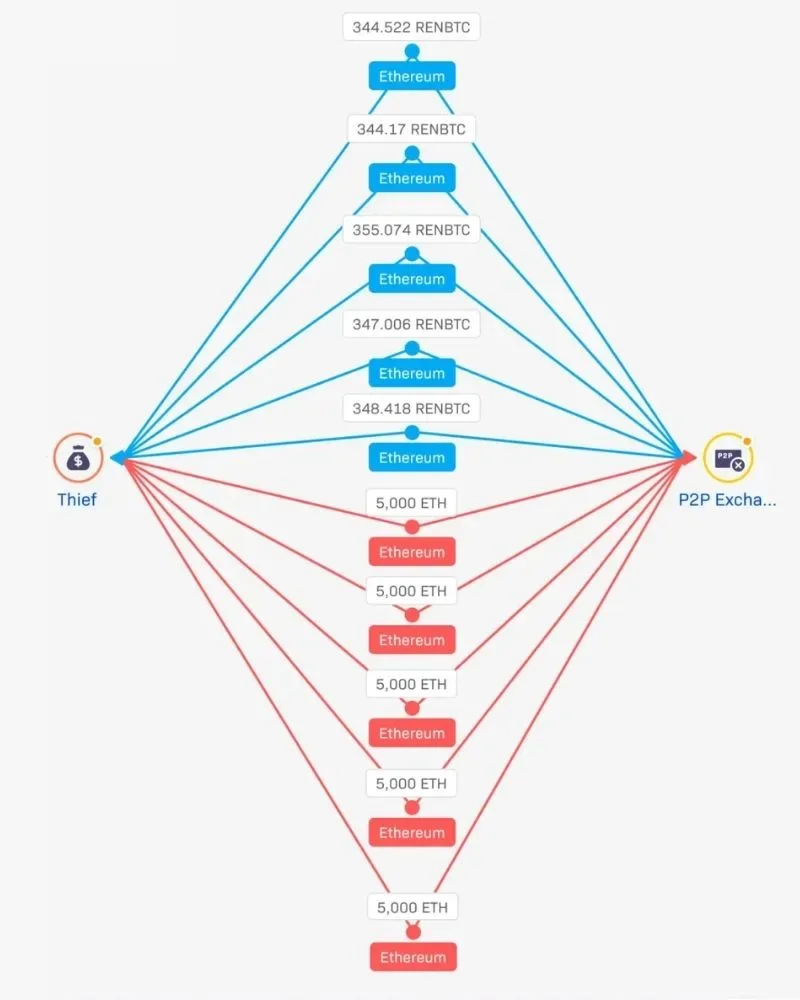
The ethereum transfers, too, followed a clearly recognisable pattern.
The stolen ETH were first forwarded to a DeFi protocol, converted there into USDT and then transferred via the TRON blockchain. From there, further movements took place through wallets with known risk markers.
AQ Forensics reconstructed every step using publicly visible blockchain data and smart contract interactions.
With every transaction analysed, a more precise picture of the movements of money emerged.
Slowly it became visible how professionally the perpetrators had proceeded – but also that they were not invisible.
A single wallet suddenly changed everything
One wallet stood out during the investigation.
It still contained bitcoin.
To many of those affected, such a wallet looks like a final full stop. For professional blockchain forensics, however, it can become the decisive point of departure.
We explained to our client: a blockchain wallet cannot be „hacked“. But it can be watched.
Every movement leaves traces – visible to anyone who knows what to look for.
So we began to monitor.
Day after day.
Week after week.
And then, suddenly, there was movement in the case.
The moment that changed everything
One morning we received a message from ChangeNOW:
„We were able to intercept close to $100,000 in BTC. Please notify the Liechtenstein authorities immediately.”
Shortly afterwards the authorities confirmed that the bitcoin secured came directly from our client's stolen assets.
ChangeNOW then immediately initiated the official recovery process and transferred the assets transparently and professionally to a wallet held by the law enforcement authorities.
For our client, this moment was hard to put into words.
After months of uncertainty, shame and hopelessness, a substantial part of his digital assets could actually be secured.
A detailed account of the case was later also published by the compliance and recovery department of ChangeNOW in the official bitcoin recovery case.
Cases like this show what modern blockchain forensics can achieve today.
Why this case goes far beyond a single fraud
This case shows that even professional perpetrator groups make mistakes.
Digital flows of money can be analysed. Wallet structures can be made visible. International movements across different blockchains leave patterns.
And it is precisely these patterns that make operational investigations possible.
Above all, however, this case sends an important message to those affected: you are not alone. And you are not to blame.
Many people lose all hope after crypto fraud. That is frequently exactly what perpetrator groups count on. They expect victims to give up, to feel ashamed or not to seek help.
Modern blockchain forensics, however, is developing at the same pace as the perpetrators' methods.
That is why there can still be movement in a case even months later.
Key terms from blockchain forensics explained simply
social engineering
Here, perpetrators deliberately manipulate people in order to build trust and obtain money or sensitive information. This frequently happens through chats, social networks or supposed investment platforms.
blockchain forensics
Blockchain forensics describes the professional analysis of cryptocurrency transactions, wallets and digital flows of money. The aim is to trace assets, make connections visible and support investigations technically.
Wallet
A wallet is a digital address for cryptocurrencies such as bitcoin or ethereum.
TXID / hash value
Every blockchain transaction has a unique identifier. This helps investigators trace movements of money precisely.
DeFi protocol
DeFi stands for „decentralized finance“. What is meant are blockchain-based financial applications through which cryptocurrencies can be exchanged or transferred automatically.
What those affected should do after fraud involving cryptocurrencies
Anyone who becomes the victim of fraud involving cryptocurrencies is frequently under enormous emotional pressure. Many of those affected react at first with shock, uncertainty or shame.
That is precisely why acting quickly and in a structured way is so important.
First, a police report should be filed as early as possible. Even more important, however, is to secure all available data and digital traces immediately after the incident:
- wallet addresses
- TXIDs
- screenshots
- chat histories
- websites
- telephone numbers
- communication data
In the next step, a specialised and certified blockchain forensics firm such as AQ Forensics should be brought in as quickly as possible. Professional cryptocurrency investigators analyse the available data, reconstruct digital flows of money, identify relevant wallet structures and initiate operational measures towards the possible seizure of assets.
AQ Forensics regularly works with the compliance departments of international crypto platforms and with law enforcement agencies in order to trace digital assets technically and create the basis for a later return of seized funds to those affected.
Above all, however, those affected should know one thing: there is help. And there is hope.
Anyone who has become the victim of fraud involving cryptocurrencies will find here further information and professional help with crypto fraud and blockchain forensics.
AQ Forensics provides support with
blockchain analysis, wallet risk assessments, source-of-funds checks & crypto investigations
Über den Autor
Albert Quehenberger is founder and managing director of AQ Forensics GmbH and a specialist in blockchain forensics, cryptocurrency investigations and digital asset analysis. With more than a decade of experience in intelligence, digital investigations and blockchain analysis, he supports companies, banks, lawyers, authorities and private individuals in investigating crypto fraud cases, asset tracing and analysing complex financial flows on public blockchains.
His career includes more than six years in military intelligence, a master's degree from the WU Executive Academy, specialist training for court-appointed experts and training as an election observer to OSCE/ODIHR standards. He is also a member of the expert council of the European Institute for Future Generations (EIFG), a ChangeNOW ambassador and an adviser for Web3 education programmes in Ethiopia.
Further analyses & case studies
- // AQ FILES 001 – Anatomy of an international pig butchering fraud
- // AQ CASES 002 – Asset recovery in practice
- // AQ ECOSYSTEM 002 – TokenPay and AQ Forensics enter into