

Anatomy of an International Pig Butchering Fraud
How a German investor became the victim of a professionally organised cryptocurrency fraud
Within a few weeks, a German investor lost a high six-figure USDT amount to a supposed investment platform. What began as an ordinary contact via social media developed into a complex international cryptocurrency fraud involving psychological manipulation, professionally designed platform infrastructure and internationally distributed money laundering processes. The subsequent blockchain analysis by AQ Forensics revealed typical features of modern pig butchering structures: long-term trust building, simulated trading profits, rapid wallet rotation and connections to already known scam infrastructure.
Particularly striking was the combination of emotional manipulation, professional platform design and highly structured blockchain infrastructure.
Starting position of the case
In February 2026, a German victim contacted AQ Forensics after losing a high six-figure USDT amount. According to the victim, the first contact was made through an international social media platform.
The perpetrator presented herself as a successful entrepreneur with extensive experience in cryptocurrency trading and international investments. Over several weeks the communication developed into an intensive personal exchange.
The perpetrator deliberately conveyed:
- economic success
- financial competence
- supposed insider knowledge
- exclusive access to trading strategies
As trust grew, the perpetrators recommended acquiring cryptocurrencies through regular exchanges and then transferring them to wallet addresses of a supposed investment platform.
Through professional design, high-quality user interfaces and simulated real-time trading data, the platform used conveyed the impression of a legitimate cryptocurrency exchange.
Modern pig butchering structures specialise less in technical exploits than in systematic psychological manipulation.
If you are unsure whether you are affected, have your case examined discreetly. AQ Forensics supports victims with the analysis of international cryptocurrency fraud cases through blockchain forensics, wallet tracking and structured preservation of evidence.
What is a pig butchering fraud?
A pig butchering fraud is a form of cryptocurrency investment fraud in which perpetrators build trust with their victims over a longer period before moving them to ever larger investments.
The term comes from English and describes figuratively the „fattening“ of a victim before the financial loss. Unlike classic fraud models, pig butchering structures do not rely on rapid pressure or obvious deception.
Rather, the perpetrators combine:
- long-term trust building
- emotional attachment
- professional communication
- simulated profits
- supposedly exclusive investment opportunities
The aim is to increase the investment amounts step by step until substantial assets have been transferred.
Only then are withdrawals blocked and additional payments demanded.
The building of trust before the investment
A central element of the case was the deliberate psychological preparation. The perpetrator invested considerable time in building a personal relationship with the victim.
The communication was regular, friendly and professional. Financial topics were at first mentioned only in passing. Only once a stable relationship of trust had formed did the introduction to the supposed investment opportunities begin.
This approach corresponds to a pattern that AQ Forensics regularly observes in international pig butchering investigations. The investment is not presented as a risk, but as the logical consequence of a relationship of trust that has already been built.
The role of the fake investment platform
The platform used was professionally designed and conveyed the impression of a regular trading environment.
What was displayed included:
- trading profits
- arbitrage returns
- VIP levels
- trading volumes
- account balances
- apparently available withdrawals
For the victim there was initially no obvious indication that the platform was manipulated.
Particularly effective was the execution of small test withdrawals. These withdrawals served not to pay out profits, but to build trust.
Why the first withdrawals were so important
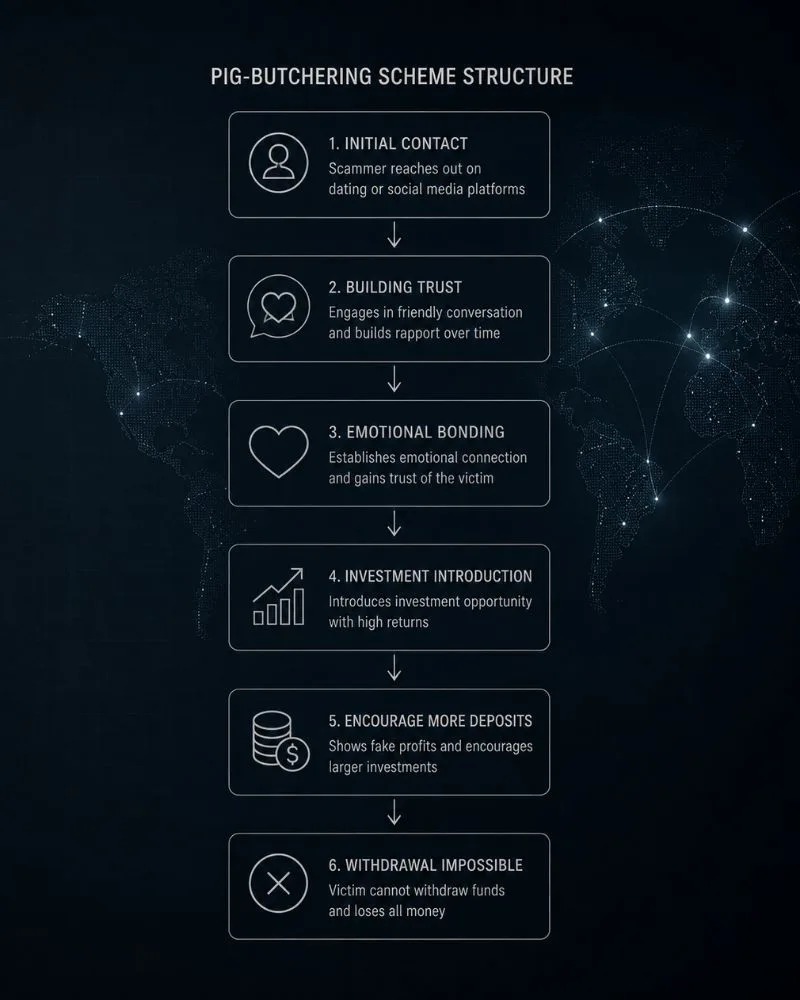
One of the decisive factors in the case was the successful execution of small withdrawals at the start of the investment. For many victims such withdrawals are the final proof that the platform is operating legitimately.
That is precisely why perpetrators use them deliberately.
Once trust had been consolidated, the investment amounts increased step by step. With every deposit, the emotional and financial attachment to the system grew as well.
In retrospect it became clear that the early withdrawals were an essential part of the manipulation strategy.
The first warning signs of the pig butchering fraud
After several additional deposits, the situation suddenly changed.
Withdrawals were blocked.
At the same time the operators demanded further payments for:
- supposed tax releases
- AML verifications
- proof of liquidity
- security checks
Although further payments were made, the assets were not released. In parallel, the platform continued to display rising profits.
It is precisely this combination of an apparent account balance and the absence of any possibility of withdrawal that is among the typical features of international pig butchering structures.
The perpetrators did not act opportunistically, but according to standardised operational procedures.
Blockchain analysis and investigative approaches
The blockchain forensic investigation concentrated on analysing the wallet addresses used and tracing the assets transferred.
Even in the early phase of the investigation, a striking pattern emerged. The wallets used were active only briefly and forwarded incoming assets almost immediately.
Within a few minutes, several incoming USDT transfers were moved through numerous intermediate wallets and then consolidated.
The investigation identified:
- temporary deposit wallets
- rapid wallet rotation
- forwardings synchronised in time
- layering processes
- peel chain structures
- collection wallets close to exchanges
In addition, connections could be established to wallet structures already documented in other fraud investigations.
The international perpetrator infrastructure
Alongside the blockchain analysis, the platform used was also examined.
Several typical features of fraudulent infrastructure emerged:
- no demonstrable regulation
- obscured operator structure
- absence of company details
- manipulated trading data
- simulated profits
- reused scam components
In addition, the regulatory review showed that public warnings from European financial supervisory authorities against the platform already existed.
Both the Austrian Financial Market Authority and the German BaFin had published notices stating that the platform did not hold the necessary authorisations.
This circumstance shows how professionally modern fraud platforms are designed and why many victims invest despite the warnings that exist.
Public warnings alone are frequently not enough to protect victims from professionally designed investment platforms.
What those affected by a pig butchering fraud should do
Where cryptocurrency fraud is suspected, AQ Forensics recommends in particular:
- make no further payments
- document wallet addresses
- secure all communication data
- trace exchange transfers
- take screenshots of the platform
- check suspicious platforms against regulatory records
- have a blockchain analysis carried out early
With professionally designed investment platforms in particular, securing relevant data early can be decisive for subsequent investigative measures.
If you already have a suspicion or have become the victim of crypto fraud, contact AQ Forensics for a professional analysis and the preservation of evidence of your transactions.
Have your case examined without obligation
We analyse your case confidentially and discuss together which measures and next steps are possible.
Closing remarks
This case illustrates the increasing professionalisation of modern pig butchering structures as well as the importance of early blockchain analysis and structured investigative measures.
The perpetrators combine psychological manipulation, professional platform infrastructure and international money laundering processes into operationally highly developed fraud models.
At the same time the investigation shows that modern cryptocurrency fraud structures have long since ceased to be isolated individual cases and are increasingly part of professionally organised transnational scam infrastructure.
Analysing such cases today requires a combination of blockchain forensics, wallet tracking, OSINT research and regulatory assessment in order to understand the actual background of the perpetrator structures.
Über den Autor
Albert Quehenberger leads international investigations in the fields of cryptocurrency fraud, blockchain forensics and digital asset analysis.
His work focuses on the analysis of transnational scam infrastructure, wallet tracking, money laundering processes and the structured investigation of organised crypto crime.

Further cases from the AQ Fraud Intelligence Library
- // AQ FILES 002 – Anatomy of a romance scam involving cryptocurrencies
- // AQ FILES 003 – Anatomy of an international crypto Ponzi scheme
- // AQ FILES 009 –Anatomy of a fraud with stolen cryptocurrencies