
Russian Sanctions Evasion Using Cryptocurrencies
Why blockchain forensics is becoming a geopolitical investigative instrument
International sanctions have for decades been among the most important instruments of geopolitical influence. They are intended to isolate states, companies and individuals economically and to impede access to international financial systems. With the rise of digital assets, however, the structure of global financial flows is changing fundamentally. Cryptocurrencies enable cross-border transfers of value outside traditional banking systems. This creates new opportunities for international trade relations – but also new challenges for supervisory authorities, investigators and compliance departments. Russia in particular is increasingly associated with building alternative blockchain-based payment structures. The consequence: blockchain forensics is developing from a specialised niche discipline into a strategic tool of modern financial investigations.
The new reality of international sanctions
Traditional sanctions are based on controlling conventional financial infrastructure. Banks, SWIFT networks and international payment service providers form the basis of economic influence.
Cryptocurrencies change this model.
Digital assets enable transactions without conventional financial intermediaries. Companies and private individuals can transfer value worldwide without depending on traditional banking structures.
This creates new challenges for regulators and investigators.
According to Chainalysis and other international analysis houses, sanctioned networks use in particular:
- stablecoins
- OTC brokers
- peer-to-peer trading
- alternative payment networks
- cross-chain infrastructure
- international wallet networks
„International sanctions are increasingly directed not only at bank accounts, but at digital financial infrastructure.“
Why stablecoins are at the centre
While bitcoin frequently receives the public attention, stablecoins play a considerably more important role in international payment networks.
Companies need stable units of account. Stablecoins combine the advantages of conventional currencies with the speed and flexibility of public blockchains.
Particularly attractive are:
- price stability
- global availability
- fast transfers
- low costs
- high liquidity
Blockchain forensics is changing international investigations
A widespread misconception is to regard cryptocurrencies as anonymous.
In fact, public blockchains leave permanent data traces.
This is exactly where modern blockchain forensics comes in.
Investigators analyse:
- wallet relationships
- transaction clusters
- stablecoin flows
- exchange exposure
- cross-chain transfers
- risk networks
With the help of modern analysis platforms, complex payment networks can be reconstructed and visualised.
Wallet intelligence as a new investigative discipline
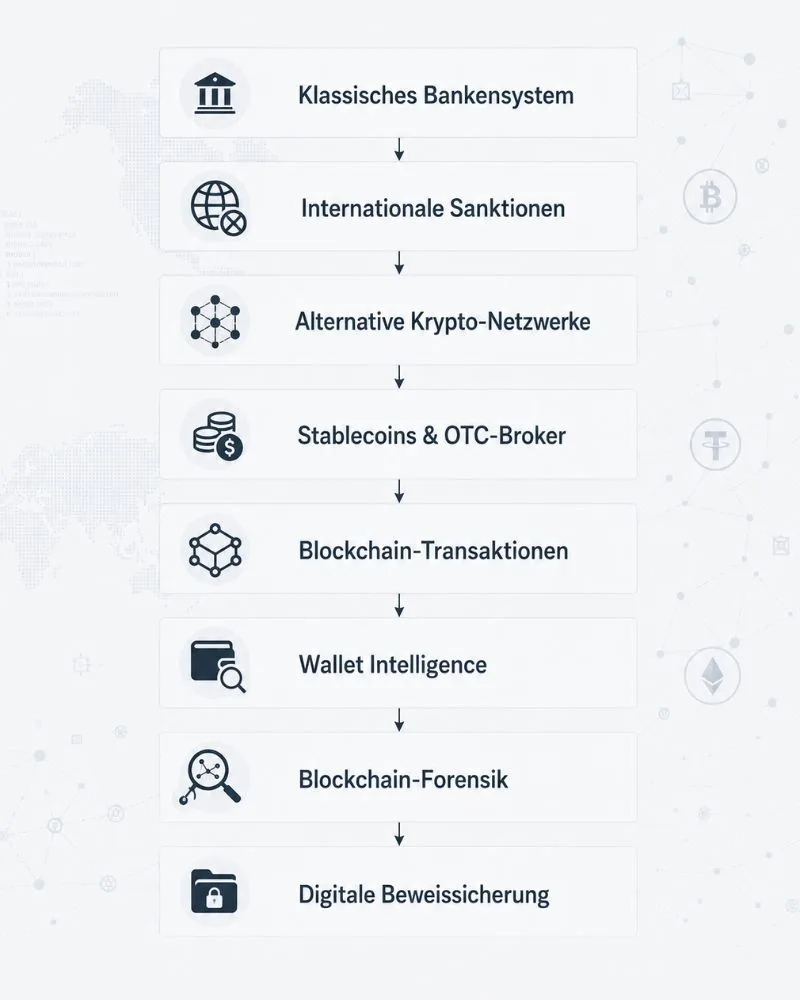
Analysing individual transactions is frequently no longer enough today.
Increasingly, the focus is on examining entire networks.
Modern wallet analysis methods enable:
- wallet clustering
- network visualisation
- risk assessment
- exchange attribution
- behavioural analysis
- source-of-funds checks
Effects on companies, compliance and investigations
This development has long since ceased to concern only governments or law enforcement agencies.
Companies, financial service providers and law firms, too, increasingly face regulatory requirements.
Particularly critical are:
- stablecoin payments
- wallets of unknown origin
- international crypto transactions
- digital assets with an unclear source of funds
This is why source-of-funds analysis and blockchain-based compliance checks are becoming increasingly important.
„The most important compliance question of the coming years is no longer only who carried out a transaction – but what story the wallet behind it tells.“
The future of crypto compliance
Three developments are already clearly emerging today:
- Blockchain forensics is becoming standard.
- Compliance is becoming crypto-native.
- Wallet intelligence is developing into a core competence of modern financial investigations.
AQ Forensics supports companies, law firms, financial service providers and authorities with
blockchain analysis, wallet risk assessments, source-of-funds checks & crypto investigations
Über den Autor
Albert Quehenberger is founder and managing director of AQ Forensics GmbH and a specialist in blockchain forensics, cryptocurrency investigations and digital asset analysis. With more than a decade of experience in intelligence, digital investigations and blockchain analysis, he supports companies, banks, lawyers, authorities and private individuals in investigating crypto fraud cases, asset tracing and analysing complex financial flows on public blockchains.
His career includes more than six years in military intelligence, a master's degree from the WU Executive Academy, specialist training for court-appointed experts and training as an election observer to OSCE/ODIHR standards. He is also a member of the expert council of the European Institute for Future Generations (EIFG), a ChangeNOW ambassador and an adviser for Web3 education programmes in Ethiopia.

Further analyses & case studies
- // AQ INSIGHTS 002 – Crypto mixers in blockchain forensics
- // AQ INSIGHTS 001 – Reconstructing cross-chain swaps
- // AQ ECOSYSTEM 002 – TokenPay and AQ Forensics enter into a strategic partnership