

When Self-Custody Fails: What Recent Bitcoin Thefts Reveal About Wallet Security, Key Generation and Infrastructure
Executive Summary
Several recent security incidents in the Bitcoin environment show that protecting crypto assets goes far beyond merely holding a private key. At BTCPay Server, a critical vulnerability allowed unauthorised access to the credentials of an LND instance. As a result, affected Lightning nodes could be compromised and funds transferred.
At COLDCARD, a firmware bug meant that seed generation – the creation of a wallet's cryptographic starting value – did not, under certain conditions, fall back on the hardware random number generator as intended. Instead, a software-based PRNG could be used. A PRNG does not generate random values directly from a physical source of randomness, but calculates them from an internal starting state.
Where this starting state was too predictable, considerably less entropy – that is, actual unpredictability – was available for seed generation than intended.
As a result, the effective key space, meaning the number of practically possible keys, could shrink considerably.
In parallel, reports emerged about an allegedly counterfeit Wasabi wallet application in the Apple App Store, through which a user is said to have lost around six bitcoin. Irrespective of the final assessment of this specific case, the incident reveals another important weakness: the route by which wallet software is obtained is also part of the security model.
The three cases concern different technical layers, but lead to the same conclusion: The security of a blockchain and the security of the assets managed on it are not the same thing.
Bitcoin can function entirely correctly at protocol level while assets are lost through compromised credentials, weak key generation, manipulated software or faulty infrastructure.
„The blockchain does not have to be compromised. It is enough to control one security-critical component between the blockchain and the user.“
Bitcoin was not „hacked“
When bitcoin is stolen, it is often described in shorthand as bitcoin itself having been „hacked“.
Technically, that is not correct in most cases. The Bitcoin network checks whether a transaction meets the cryptographic conditions required to spend the bitcoin in question.
It does not, however, check why a valid signature was created, or whether the person holding the necessary key is actually entitled to dispose of the assets.
Once an attacker has gained access to a private key or to infrastructure capable of authorising a transaction, the blockchain initially sees only one thing: a technically valid transaction.
A realistic security assessment therefore has to distinguish between several layers.
Protocol Security
This concerns the question of whether the Bitcoin protocol or the consensus mechanism itself has been compromised.
Key Security
Here the focus is on the security of the private key or the seed. Can an attacker reconstruct it, read it out or otherwise control it?
Endpoint Security
This concerns the end device. Is the computer or smartphone on which wallet software runs or a transaction is prepared trustworthy?
Infrastructure Security
This looks at nodes, APIs, credentials and administrative interfaces.
Supply Chain & Software Distribution
This is about whether hardware, firmware and wallet software genuinely come from a trustworthy source and are unaltered.
Human Security
And finally, people themselves remain part of the security model. Phishing, fake support or social engineering can bypass even technically excellent protective measures.
Only when these layers are considered together does a realistic picture of actual security emerge.
Case 1: BTCPay Server – when credentials lead to control over a Lightning node
In early August 2026, BTCPay Server published a critical security advisory for versions prior to 2.4.2.
According to the project, an unauthenticated attacker could, under certain conditions, access the .macaroon files of a connected LND instance.
BTCPay confirmed that the vulnerability was actively exploited, that users were affected and that funds were stolen.
At the same time, the scope of the incident was clearly delimited: The regular BTCPay on-chain wallets were not affected by this specific attack. What was affected was the LND environment. Balances managed within an LND node could, however, be part of the exposed infrastructure.
What is a macaroon?
LND uses what are known as macaroons as cryptographically secured authorisation credentials.
Put simply, they work much like digital access keys to which specific rights are assigned. Depending on the scope of those rights, a macaroon may, for example, allow information to be read from a node or certain functions to be executed.
A macaroon is not a Bitcoin private key.
Operationally, a sufficiently privileged macaroon can nevertheless be similarly critical: whoever controls it may be able to execute a node's functions without knowing the actual wallet seed.
The case therefore illustrates very clearly why the simple notion
„As long as nobody knows my seed, my bitcoin is safe“
is not sufficient for more complex infrastructures.
The actual attack vector
The attack vector – the specific technical route of attack – did not lie in the Bitcoin blockchain here.
Nor was the mathematical security of the underlying signature schemes broken. What was attacked was an authorisation layer within the infrastructure.
That is a decisive difference. Alongside seed phrases and private keys, other components must therefore also be treated as highly sensitive secrets:
- LND macaroons
- API keys
- RPC credentials
- session tokens
- administrative credentials
- configuration files containing credentials
- backup and wallet files
- secrets within server or container environments
The central question is therefore not only:
„Where is my private key?“
but:
„Which other components can enable disposal of my assets, directly or indirectly?“
Why the attack surface is decisive
In IT security, the totality of all technically reachable attack opportunities is referred to as the attack surface.
The more services a system exposes to the outside, the larger this attack surface generally becomes.
This may include, for example:
- open ports
- reverse proxies
- external APIs
- remote access
- Tor services
- administrative web interfaces
BTCPay advised operators who could not update immediately to take affected LND installations temporarily offline.
The case also illustrates an important principle:
„A patch fixes a specific vulnerability. It does not replace a review of the entire attack surface.“
A system can therefore be correctly updated and still remain exposed through other, self-configured access routes.
In short:
„A Lightning node is payment infrastructure – not a long-term vault.“
Case 2: COLDCARD – the security flaw in seed generation
The COLDCARD incident concerns an even more fundamental layer. Here it was not a matter of extracting an already securely generated private key from a device.
According to the published technical analyses, the problem lay at the stage of seed generation itself.
Put simply, the seed is the cryptographic starting point of a deterministic wallet. The associated private keys and addresses can later be derived from it.
Coinkite and Block published detailed analyses of a bug within the random number generation of the COLDCARD firmware. The cryptographic library itself was not the problem. What mattered was its integration into the firmware.
The technical fault
COLDCARD had originally used a hardware-based random number generator. Such a hardware RNG produces random values using a dedicated hardware component.
In the course of a later firmware change, seed generation was moved to a different code path.
This path did not, however, fall back on the hardware RNG as intended. Instead, MicroPython's software-based Yasmarang PRNG could be used. A PRNG – pseudo random number generator – produces values deterministically from an internal starting state. That is not inherently insecure.
Modern cryptographic systems regularly use secure PRNGs. It becomes problematic, however, when the internal starting state contains only little genuine entropy. That is exactly where the risk lay.
Why the fault was so serious
A particularly problematic aspect was a build configuration in which an RNG function was treated as present in the code but was in fact disabled.
Put simply, what was checked was:
„Does this function exist?“
but not, sufficiently:
„Is the secure hardware function actually being used?“
As a result, the firmware could be built successfully even though a different random number generator from the one intended was used for seed generation.
From a software security perspective, that is an important insight:
„What matters is not which security code exists somewhere in the system. What matters is which code is actually executed at runtime.“
A PRNG is not automatically insecure
For less technically versed readers in particular, a clarification is important here.
PRNG does not automatically mean „insecure“. A cryptographically secure PRNG can produce very secure random values.
What matters is how it is initialised. The internal starting value of a PRNG is often referred to as the seed state.
If this state is sufficiently unpredictable, the output generated from it can also be cryptographically secure.
If, on the other hand, the starting state is severely constrained or partly predictable, the later output can only come from a limited set of possible values.
And that is precisely what becomes critical when Bitcoin keys are generated.
Why entropy is decisive
In this context, entropy describes, put simply, the amount of actual unpredictability.
The higher the entropy, the greater the number of realistic possibilities from which a key can originate.
With a correctly generated cryptographic key, this space is so large that exhaustively trying every option is practically impossible.
If entropy drops significantly, however, this so-called key space is reduced.
The key space is the set of all keys an attacker would theoretically have to check.
The smaller this space becomes, the more realistic a so-called brute-force search becomes – that is, systematically trying out possible keys.
Why hashing does not repair missing entropy
This point is frequently misunderstood. A weak random value can subsequently be processed by a hash function and then look like a completely random 256-bit value.
That does not mean, however, that additional security has been created.
A hash function can distribute existing information. It cannot, however, create additional unknown information.
A simple example: Suppose a system can only produce one million different starting values because of a faulty source of randomness. Even if each of these values is then hashed with SHA-256, only one million relevant possibilities still exist. The results may look like random 256-bit values. An attacker, however, still only has to check those one million candidates.
The fundamental principle is:
„Hashing distributes entropy. Hashing does not create entropy.“
How far was the key space reduced?
The effects differ according to device generation and configuration. Coinkite currently estimates the effective search space for certain affected Mk2/Mk3 configurations at approximately 40 bits. On later devices such as Mk4, Q and Mk5, additional entropy was contributed by secure elements.
A secure element is a specially hardened hardware component designed to protect cryptographic functions and secrets. This reduced the impact.
According to the manufacturer, the originally intended security level was nevertheless not fully reached. Current estimates there assume roughly 72 bits of effective entropy against an intended level of 128 bits.
For non-technical readers, one thing above all is decisive: a reduction from 128 bits to 40 or 72 bits is not a small deterioration.
It changes the effort required for a possible attack by enormous orders of magnitude.
The security of cryptographic keys rests precisely on the fact that searching the entire key space is practically impossible.
If this space is heavily reduced, the threat model – the question of which attacks become practically realistic – changes fundamentally.
No physical access to the hardware wallet required
What is special about this scenario: an attacker does not necessarily have to steal the hardware wallet. They do not have to extract a private key from a secure element. They may never have to touch the device physically at all.
If the possible key space is small enough and the attacker holds information with which candidate seeds can be verified, the search can be conducted entirely offline.
A known Bitcoin address or an extended public key can serve as the means of verification.
The attacker generates possible seeds, derives the corresponding public keys or addresses from them and compares these with the target wallet.
If they find a matching candidate, they can reconstruct the associated key material from it.
The on-chain consequences
From 30 July 2026 onwards, TRM Labs documented several waves of outflows from wallets presumed to be affected.
At the time of publication, the preliminary damage estimate stood at around 1,816 BTC from more than 5,200 addresses, corresponding to a value at the time of approximately 116 million US dollars.
These figures were expressly classified as preliminary.
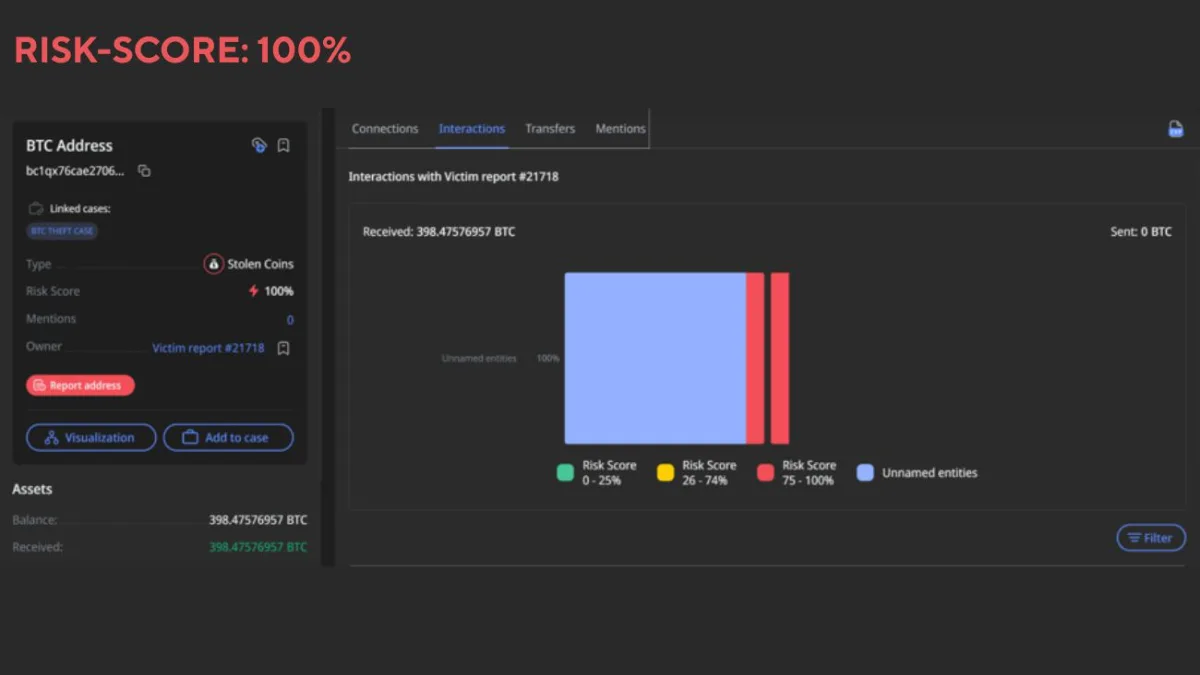
Whether all observed outflows can be attributed to the same perpetrator or the same group of perpetrators also remains an open question.
Differences in the structure of individual transactions may point to different approaches or different actors.
Forensically, a clean distinction is necessary here:
„On-chain patterns can provide indications of common control. They do not, however, replace robust attribution.“
In blockchain forensics, attribution means assigning an address, wallet or cluster to a particular service, company or actor.
Such an assignment regularly requires more than the visible blockchain transactions alone.
Why a firmware update does not repair an old seed
A firmware update can correct future seed generation. A seed that has already been generated does not change as a result. If its creation was affected, the update does not make it secure retroactively.
Two entirely different processes therefore have to be distinguished.
Patch The technical fault in the system is fixed.
Key migration The potentially insecurely generated key material is replaced with new key material.
For affected users, according to the current manufacturer guidance, this generally means: check whether the firmware in use was affected, verify and install the corrected firmware, generate a completely new seed, check the wallet fingerprint and receiving address, first carry out a small test transaction, then migrate the remaining holdings. A potentially affected seed should not simply be imported into a new hardware wallet. Because:
„The vulnerability does not necessarily lie in the device on which a seed is stored today. It may already have arisen when that seed was created.“
What dice rolls and passphrases can change
Among other things, COLDCARD makes it possible to introduce additional entropy into seed generation through dice rolls, that is, physical throws of dice.
The idea behind this is simple: every independent and secret dice roll supplies additional information that an attacker does not know. If enough fair and independent dice rolls were used, this can make a considerable additional contribution of entropy.
A BIP39 passphrase works differently. It does not repair a weak seed. Together with the mnemonic, however, it leads to a different wallet derivation and can thus represent an additional protective layer – provided it is strong, independent and not compromised.
The general principle is: multiple protective mechanisms only increase security if they are genuinely independent of one another.
Case 3: Fake wallets – when the software distribution channel itself becomes the attack
A completely different attack vector concerns counterfeit wallet applications. In August 2026, there were public reports of an allegedly counterfeit Wasabi wallet in the Apple App Store. According to the reports currently available, at least one user is said to have lost around six bitcoin as a result.
At the time of this analysis, this specific loss is not confirmed by a primary source such as Wasabi or Apple to the same standard as the BTCPay and COLDCARD incidents described above. The underlying security problem is nevertheless clear.
Wasabi describes its official software as a desktop wallet and provides installation packages for Windows, macOS and Linux. The official documentation also recommends obtaining the software from the official sources and verifying the published signatures.
Why an app store is not a guarantee of authenticity
An official app store creates trust. That trust is understandable. With wallet software, however, it should not be the only security check.
An app store can confirm that an application was offered through its platform. It cannot, however, guarantee to the user in every case that an application genuinely comes from the project whose name or appearance it uses.
With wallet software, the path of trust should therefore be reversed.
Not: app store → search for wallet → install
but: official project website → software listed there → verify developer or signature → install Name, logo and screenshots are not cryptographic proof of authenticity.
Why fake wallets do not need sophisticated malware
A counterfeit wallet does not have to exploit a zero-day. It does not have to extract a private key from a hardware wallet. In the simplest case it merely has to convince the user to enter their recovery phrase themselves.
That is precisely why such applications are so dangerous. The 12 or 24 words of a recovery phrase are not merely a password for a particular app.
In deterministic wallet systems, they form the basis for deriving the private keys.
If an attacker knows these words – and, where applicable, the additional passphrase used – they no longer necessarily need the original hardware wallet or smartphone. The wallet can be reconstructed on another system.
„Never enter your seed“ is too sweeping
The frequent advice never to enter a seed phrase anywhere is well meant, but technically too sweeping.
In a legitimate wallet recovery, a recovery phrase naturally has to be entered on a trustworthy target system.
The correct rule is therefore:
„A recovery phrase may only be entered as part of a deliberately initiated recovery process, on a previously verified and trustworthy system.“
It never belongs in:
- websites
- support chats
- emails
- messengers
- cloud documents
- online forms
- remote support sessions
- wallet applications that have not been verified beyond doubt
No reputable wallet manufacturer, support service or blockchain forensic specialist needs a victim's full recovery phrase.
Neither private keys nor seed phrases are needed for an on-chain analysis either.
Why „not your keys, not your coins“ is not enough as a security model
The well-known principle
„Not your keys, not your coins“
remains correct.
Above all, however, it answers the question:
Who holds technical control over the keys?
It does not answer:
- How were the keys generated?
- Was the entropy sufficient?
- Which firmware was involved?
- Is the hardware wallet authentic?
- Which software prepares transactions?
- Which credentials can move assets indirectly?
- Where are the backups?
- Which components share common weaknesses?
- Can a compromised end device manipulate transaction data?
- Can social engineering induce the user to reveal their seed?
For a robust self-custody architecture, mere control over the private key is therefore not enough.
The security model of a wallet
A secure wallet does not consist of a single protective mechanism.
It consists of several layers that have to work together.
1. Entropy layer
Where does the randomness for the seed come from? Is it sufficient and cryptographically robust?
2. Key generation
How is the key material actually created? Which software and which hardware are involved?
3. Key storage
Where are private keys and recovery information kept? Do additional digital copies exist?
4. Signing process
What information is displayed before a signature? Could a compromised computer display a false destination address, for example?
5. Firmware
Is the firmware in use authentic and up to date?
6. Coordinator
In more complex setups, a computer or wallet software often creates the transaction before it is signed by the hardware wallet.
This preparatory system is referred to as the coordinator. Its security is relevant too.
7. Infrastructure
Which nodes, APIs, credentials and administrative interfaces exist?
8. Recovery
How are backups secured? Is it known how the wallet will be restored in an emergency?
9. Human layer
What risks arise from phishing, fake support and social engineering?
Only the totality of these layers describes the actual level of security.
Hardware wallet security: a hardware wallet is not the same as cold storage
A hardware wallet is a specialised device for securely managing and using cryptographic keys. Cold storage, by contrast, is an entire security concept.
A user can therefore own a technically excellent hardware wallet and still run an insecure setup.
A simple example: the seed is generated correctly on the hardware wallet. The user then photographs the recovery phrase with their smartphone.
The photo is automatically synchronised to the cloud. The private key may never have left the hardware wallet.
The information from which it can be fully reconstructed is nevertheless sitting on an internet-connected system. The protective effect of the hardware wallet has thus been undermined at a decisive point.
„What matters is not only where the private key is stored. What matters is where enough information exists to restore it.“
Multisig: more keys do not automatically mean more security
A 2-of-3 multisignature structure can considerably reduce the risk of a single compromised key. In such a multisig structure there are, for example, three keys, at least two of which are needed to release a transaction.
That can represent a substantial gain in security. But only if the keys are genuinely secured independently of one another.
If, for example, three hardware wallets are used, but:
- all devices are based on the same technical architecture,
- all seeds were generated through the same faulty process,
- all backups are kept in the same place,
- all devices are coordinated through the same compromised computer,
then common sources of failure still remain. In security terminology these are known as common failure modes – weaknesses through which several protective mechanisms can fail simultaneously.
The number of keys alone is therefore not what matters. What matters is the independence of the individual security domains.
Practical security architecture for larger crypto holdings
Larger holdings should, as far as possible, be separated according to their purpose.
Long-term cold storage
For assets that are not moved over longer periods.
Operational wallet
For amounts needed on a regular basis.
Hot wallet
For smaller amounts and frequent use.
Lightning infrastructure
Only for the liquidity actually required for ongoing operations.
Multisignature vault
For larger holdings, where a single compromised key should not be enough to dispose of the assets on its own. The aim is compartmentalisation – the deliberate separation of different security domains.
The failure of a single domain should, as far as possible, not lead to the loss of the entire holding.
What users should review regularly
Crypto security is not a one-off setup exercise. With larger holdings in particular, the following points should be reviewed regularly:
- Are there current security advisories from the manufacturer?
- Is the installed firmware up to date?
- Does the wallet software genuinely come from the official source?
- Can the signature or hash of an installation package be verified?
- Do digital copies of the seed exist?
- On which devices have seeds or passphrases ever been entered?
- Which browser extensions are installed?
- Are unnecessarily large amounts held in hot wallets?
- Which external means of access to nodes exist?
- Which API or RPC credentials are active?
- How are physical backups distributed?
- Does the recovery process actually work?
One frequently overlooked point is particularly important here: a backup that has never been tested under controlled conditions is, for now, only an assumption.
Incident response: what really counts after a suspected wallet theft
After an actual or suspected crypto theft, speed counts. Equally important, however, is the right order of measures.
1. First establish what may have been compromised
It makes a considerable difference whether what is affected is:
- a wallet application
- an end device
- a seed
- a BIP39 passphrase
- a hardware wallet
- an API key
- LND credentials
- an exchange account
The necessary countermeasures differ accordingly.
2. Secure endangered assets – but not via the possibly compromised system
Where there is reasonable suspicion that a seed or private key has been disclosed, all assets derivable from it may be at risk. A new destination must therefore be set up with newly and independently generated key material.
Simply importing the old seed into a new hardware wallet does not remove the compromise.
3. Weigh asset containment against evidence preservation
Asset containment means securing any remaining endangered assets as quickly as possible.
Evidence preservation means not needlessly destroying digital evidence at the same time.
The two can be in conflict. A suspect computer, for example, should not automatically be reinstalled straight away.
Doing so can destroy:
- malware artefacts
- browser data
- download histories
- log files
- wallet artefacts
- timestamps
- persistence mechanisms, that is, indications of how malware established itself permanently in the system
In larger loss cases, it must therefore be decided as early as possible how assets can be secured without destroying relevant digital traces in the process.
4. Determine the point of compromise and the first unauthorised outflow
Two points in time are particularly relevant forensically. The point of compromise describes the possible moment or event at which a system, account or seed was compromised. The first unauthorised outflow denotes the first reliably identifiable transaction that was not initiated by the rightful user.
These two events need not be identical. A seed may, for example, have been compromised months before the actual theft.
5. Reconstruct the asset flow and trace stolen bitcoin
Starting from the first unauthorised transaction, the analysis examines:
- which addresses were used subsequently,
- whether balances were split or consolidated,
- which services were touched,
- whether swaps took place,
- whether bridges were used,
- whether assets moved to other blockchains,
- whether centralised exchanges or other VASPs were reached.
Two things have to be distinguished here:
Observation: what is directly visible on the blockchain?
Attribution: to whom can an address or a wallet cluster be assigned?
A transaction to a particular address can be established directly on the blockchain.
The statement that this address belongs to a particular exchange, by contrast, may require additional data sources, cluster heuristics or further intelligence.
The robustness of that assignment must be presented transparently.
6. Prioritise exchange touchpoints
An exchange touchpoint arises when stolen assets reach an identifiable centralised exchange or a comparable service.
That can be particularly relevant operationally.
A perpetrator can, however, quickly:
- transfer the balance onward,
- swap it,
- move it to other networks,
- or distribute it across further accounts.
A robust transaction chain should therefore be established as early as possible.
7. Cross-chain does not mean „the trail is lost“
A move to another blockchain does not automatically end a forensic analysis.
Bridge and swap operations can – depending on the protocol in question – be reconstructed using various characteristics.
These include, for example:
- deposit and withdrawal amounts,
- temporal correlations,
- protocol events,
- deposit addresses,
- transaction parameters,
- bridge-specific mechanisms.
What is decisive here is the quality of the evidence. A deterministic assignment, in which input and output are technically linked beyond doubt, carries different evidential weight from a probabilistic correlation, in which a connection merely appears likely on the basis of timing, amount and further indicators.
Beware of recovery scams
A crypto theft is not infrequently followed by a second attempt at fraud.
Victims are contacted by supposed investigators, hackers, representatives of authorities or recovery companies.
Typical claims are:
„Your bitcoin has already been found.“
„We can hack the wallet.“
„The exchange has frozen the balance.“
„A tax has to be paid before the payout.“
„We need your seed phrase in order to release it.“
Warning signs are in particular:
- guaranteed recovery
- high advance payments
- supposed release fees
- requests to hand over the seed phrase
- installation of remote access software
- alleged blockchain taxes
- exchange or authority contacts that cannot be verified
Blockchain forensics can reconstruct asset flows and identify operational starting points.
It can never, however, seriously guarantee that stolen assets will be returned.
Bitcoin and blockchain forensics: what blockchain forensics can actually achieve
Professional blockchain forensics does not consist merely of drawing arrows between wallet addresses on a graph. A robust analysis has to keep several layers apart.
Observation
What can be established directly on the blockchain?
Reconstruction
How are individual transactions technically connected?
Attribution
Which address or which cluster can be assigned to a service or actor?
Assessment
How robust is that assignment?
Operational relevance
Does it yield a concrete starting point – at an exchange, a payment service or another identifiable service provider, for example?
It is precisely this separation that is decisive for a comprehensible forensic analysis.
„Blockchain data shows transactions. Forensics turns them into a comprehensible and verifiable reconstruction.“
Why monitoring remains relevant after the first outflow
Stolen assets are not necessarily moved on immediately. Attackers can leave balances dormant for days, weeks or months. A later transfer in particular, however, can create a decisive service touchpoint.
With substantial losses, continuous monitoring can therefore make sense.
The relevant question is not only:
„Where are the assets now?“
but:
„What new forensically or operationally relevant situation arises with the next movement?“
„Bitcoin security protects the protocol. Asset security additionally requires secure keys, secure software, secure infrastructure and secure processes.“
Crypto crime requires swift, coordinated action.
AQ Forensics supports in handling complex crypto incidents – from blockchain forensics and operational incident response to securing and recovering digital assets.
Closing remarks
Self-custody shifts control to the user. In doing so, it also shifts responsibility. A hardware wallet is not a complete security concept. A seed phrase on paper is not a complete security concept.
An air gap is not a complete security concept. Multisig is not a complete security concept. And an official app store is not a cryptographic authority for trust.
Each of these measures addresses particular risks. None of them addresses every risk. Professional crypto security therefore does not begin with the question:
„Which hardware wallet is the most secure?“
It begins with a more fundamental question:
„Which conditions have to be met simultaneously for an attacker to be unable to gain disposal over my assets – and where within this architecture are the shared weaknesses?“
That is precisely the difference between a single security product and a robust security architecture.
„Self-custody does not only mean owning your own key. Self-custody means understanding and securing the entire chain of trust on which the security of that key, and therefore of your own assets, depends.“
Über den Autor
Albert Quehenberger is founder and managing director of AQ Forensics GmbH and a specialist in blockchain forensics, cryptocurrency investigations and digital asset analysis. With more than a decade of experience in intelligence, digital investigations and blockchain analysis, he supports companies, banks, lawyers, authorities and private individuals in investigating crypto fraud cases, asset tracing and analysing complex financial flows on public blockchains.
His career includes more than six years in military intelligence, a master's degree from the WU Executive Academy, specialist training for court-appointed experts and training as an election observer to OSCE/ODIHR standards. He is also a member of the expert council of the European Institute for Future Generations (EIFG), a ChangeNOW ambassador and an adviser for Web3 education programmes in Ethiopia.

Further analyses & case studies
- // AQ CASES 002 – Asset recovery in practice
- // AQ INSIGHTS 001 – Reconstructing cross-chain swaps
- // AQ INSIGHTS 002 – Crypto mixers in blockchain forensics
Sources & further information
- Video with 21 Bitcoin & AQ Forensics: We are hunting the Coldcard hackers: this is where the stolen bitcoin ends up! I 21weekly
- LinkedIn post by 21 Bitcoin What happens to stolen bitcoin, and how can its traces be followed on the blockchain?
- BTCPay Server – security advisory:Update BTCPay Server to 2.4.2 Immediately. Official security advisory on the critical LND credential vulnerability, the confirmed active exploit and the recommended countermeasures.
- Coinkite – Technical Deep Dive into the Entropy Issue: Technical root cause analysis of the COLDCARD security incident, including the RNG path, affected firmware versions and the impact on effective entropy.
- Block – Predictable RNG Fallback and 32-Bit Reseed in COLDCARD Firmware: Independent technical analysis of the MicroPython Yasmarang fallback, the RNG integration and the resulting reduction of the effective key space.
- TRM Labs – The Largest Hardware Wallet Exploit of 2026: Inside the USD 116 Million Coldcard Hack: On-chain analysis of the observed waves of outflows and the preliminary scale of the damage in connection with the COLDCARD security incident.
- Wasabi Wallet – Official Installation Documentation: Official documentation on supported platforms, download sources and the verification of authentic Wasabi software.
- Wasabi Wallet – Getting Started
- Apple App Store – Wasabi Bitcoin & Crypto Wallet: Primary source for the existence and presentation of the mobile application offered under this name.
- Pluang – Fake Wasabi Wallet app linked to reported theft of approximately 6 BTC: Supplementary reporting on the specific loss. At the time of this analysis, the loss of around six BTC is not confirmed by an official primary source to the same standard as the technical facts of the BTCPay and COLDCARD incidents.
INFO: Status of the analysis: 10 August 2026 In ongoing security incidents, technical findings, affected firmware versions, loss amounts and the attribution of individual on-chain activity may change in the course of further investigation.