
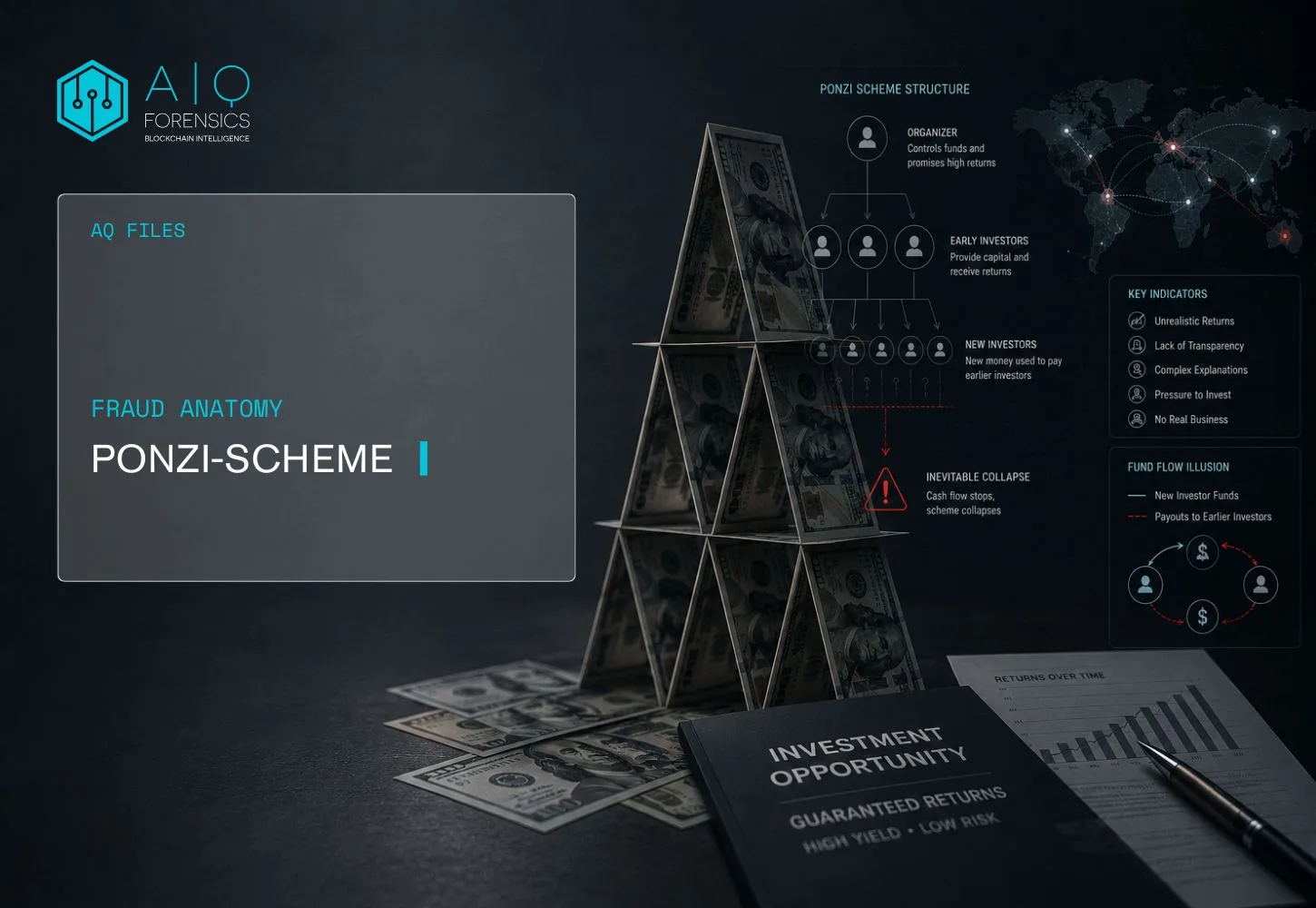
Anatomy of an International Crypto Ponzi Scheme
How a supposed Web3 company convinced hundreds of investors with AI, tokenisation and minting
Over several years, hundreds of investors from Austria, Germany, Switzerland, Liechtenstein and South Tyrol invested substantial assets in a supposedly innovative Web3 project. The operators promised access to a next-generation digital ecosystem. At the centre were artificial intelligence, a proprietary utility token, automated minting programmes and the prospect of long-term passive income streams. To many investors the concept looked modern, plausible and forward-looking. Only when payouts were delayed and later stopped entirely did the suspicion arise that the economic basis of the system might never have existed. The subsequent analysis revealed numerous features of a modern crypto Ponzi scheme that combined current technology trends with the classic mechanisms of a pyramid scheme.
Starting position of the case
The operators presented themselves as an innovative technology company focused on blockchain, artificial intelligence and digital assets. Unlike many classic investment fraud cases, the marketing did not concentrate on short-term profits or aggressive trading.
Rather, a long-term vision was conveyed. Investors were to become part of a digital ecosystem that would connect several future technologies with one another.
Presentations regularly centred on the following topics:
- artificial intelligence
- blockchain technology
- tokenisation
- Web3
- digital assets
- community economy
At the centre of the project was a purpose-built utility token. In addition, investors were offered the option of depositing their tokens within a so-called minting programme in order to generate additional returns. To many investors this model looked innovative and credible.
If you are unsure whether you are affected, have your case examined discreetly. AQ Forensics supports victims with the analysis of international cryptocurrency fraud cases through blockchain forensics, wallet tracking and structured preservation of evidence.
What is a crypto Ponzi scheme?
A Ponzi scheme is a fraudulent investment model in which payouts to existing investors are financed predominantly from the deposits of new investors. As long as sufficient new capital flows in, distributions can often be made reliably for years.
It is precisely these early payouts that are among the strongest factors of trust within such systems.
Modern crypto Ponzi structures differ considerably from the classic pyramid schemes of past decades, however.
Today, operators frequently use narratives around:
- artificial intelligence
- cryptocurrencies
- Web3
- tokenisation
- staking
- minting
- digital assets
This gives many investors the impression of an innovative technology company rather than a classic fraud model.
The vision sells better than the product
The operators were not selling a conventional investment. They were selling a vision of the future.
Investors were told that artificial intelligence analysed market cycles and enabled optimal returns within a complex digital ecosystem.
The purpose-built token was to form the foundation of this infrastructure.
Many investors therefore regarded their participation not as speculation but as part of a long-term technology project. It was precisely this perception that made the model so successful.
Why the first distributions were so important
The first participants invested amounts ranging from several thousand to several tens of thousands of euros. Within a few weeks, the first returns appeared within the platform.
In addition, numerous investors received regular distributions. To the investors the model appeared to work.
The returns received were actively communicated within the community and strengthened confidence in the project.
In retrospect, these early distributions proved to be one of the most important factors in the later growth.
The community becomes the engine of growth
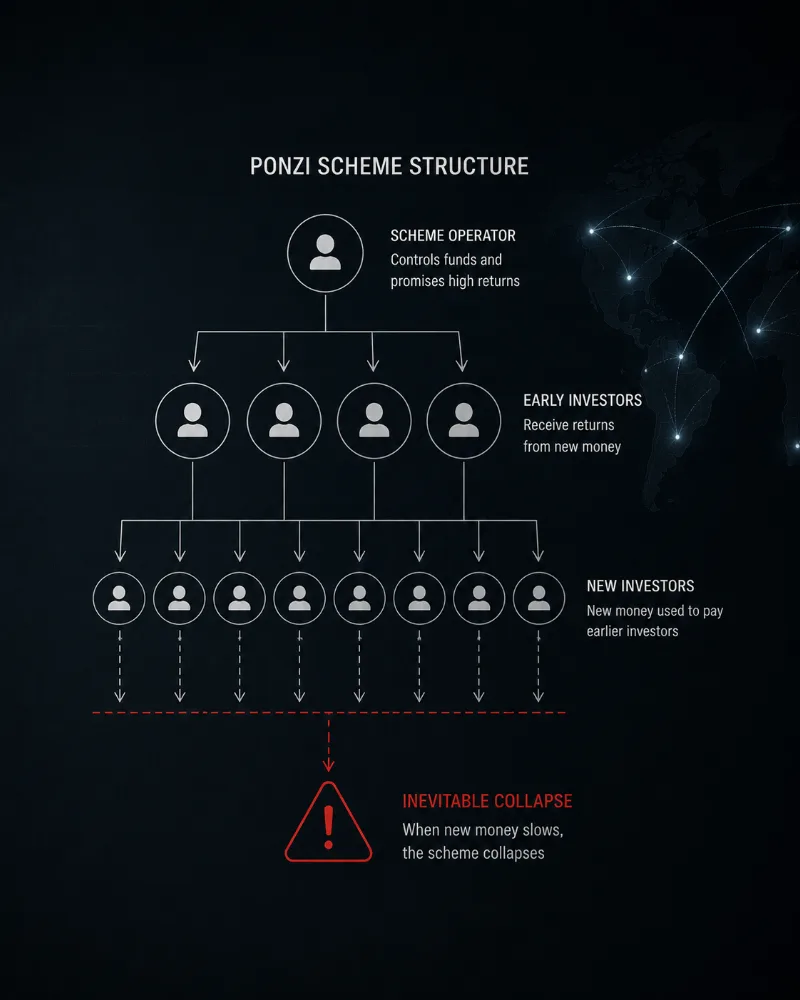
An essential part of the success was the community. Existing investors recommended the project to friends, family members and business partners.
Many new investors were won not through classic advertising but through personal recommendations.
People frequently trust the experience of their social circle more than official warnings.
As growth continued, the community became the system's most important distribution channel.
The first warning signs
For several years the model appeared to work smoothly. Then the first anomalies appeared. Payouts were delayed. Support enquiries went unanswered.
At the same time, investors were increasingly encouraged to reinvest their profits.
In parallel, several European financial supervisory authorities published warnings about comparable investment models and their business structures.
Many investors, however, interpreted these warnings as regulatory formalities.
The distributions received to date seemed more credible than abstract warnings.
Several European financial supervisory authorities had already published warnings about comparable investment models.
Blockchain analysis and investigative approaches
After the collapse, the analysis of known wallet addresses and transaction paths began.
The aim was to trace the origin, movement and possible current custody of the assets.
The investigation concentrated in particular on:
- wallet clustering
- transaction tracing
- exchange attribution
- cross-chain transfers
- treasury wallets
- asset consolidation wallets
By analysing recurring transaction patterns, several wallets could be assigned to a common economic structure.
The analysis identified recurring collection wallets through which the deposits of numerous investors were consolidated. Several transaction patterns showed structural overlaps between investor deposits and later distributions.
In blockchain forensic investigations, such patterns are frequently regarded as relevant indicators of the economic structure of an investment programme.
The collapse
Like every Ponzi system, this model too depended on a continuous inflow of new investors. Over time, however, growth slowed. The number of new investors declined.
At the same time, withdrawal demands from existing investors increased. This created a structural imbalance. The operators initially responded with technical problems, compliance checks and system migrations.
Shortly afterwards, payouts were stopped entirely. For many investors it became clear for the first time that the promised returns might never have rested on a sustainable economic basis.
„The technology itself was not the problem. Rather, real technologies were used to make an economically incomprehensible business model appear plausible.“
What those affected by a Ponzi scheme should do
Where cryptocurrency fraud is suspected, AQ Forensics recommends in particular:
- secure wallet addresses
- archive transaction data
- save communication histories
- document contract papers
- secure withdrawal requests
- check warnings from supervisory authorities
- have blockchain forensic analyses carried out
Securing digital traces early considerably improves the prospects of further investigations. If you already have a suspicion or have become a victim of crypto fraud, contact AQ Forensics for a professional analysis and the preservation of evidence of your transactions.
Have your case examined without obligation
We analyse your case confidentially and discuss together which measures and next steps are possible.
Closing remarks
The combination of artificial intelligence, tokenisation, minting, Web3 and international marketing is currently among the most effective narratives in cryptocurrency investment fraud.
That is precisely why transparency, independent checks and blockchain forensic analysis are decisive in distinguishing innovative projects from potential fraud structures.
This case shows that modern Ponzi systems frequently stand out not through unrealistic promises, but through professional marketing, strong communities and the deliberate use of current technology trends.
Über den Autor
Albert Quehenberger leads international investigations in the fields of cryptocurrency fraud, blockchain forensics and digital asset analysis.
His work focuses on the analysis of transnational scam infrastructure, wallet tracking, money laundering processes and the structured investigation of organised crypto crime.

Further cases from the AQ Fraud Intelligence Library
- // AQ FILES 002 – Anatomy of a romance scam involving cryptocurrencies
- // AQ FILES 004 – Anatomy of a RIP deal involving cryptocurrencies
- // AQ FILES 005 – Anatomy of a broker fraud involving cryptocurrencies