
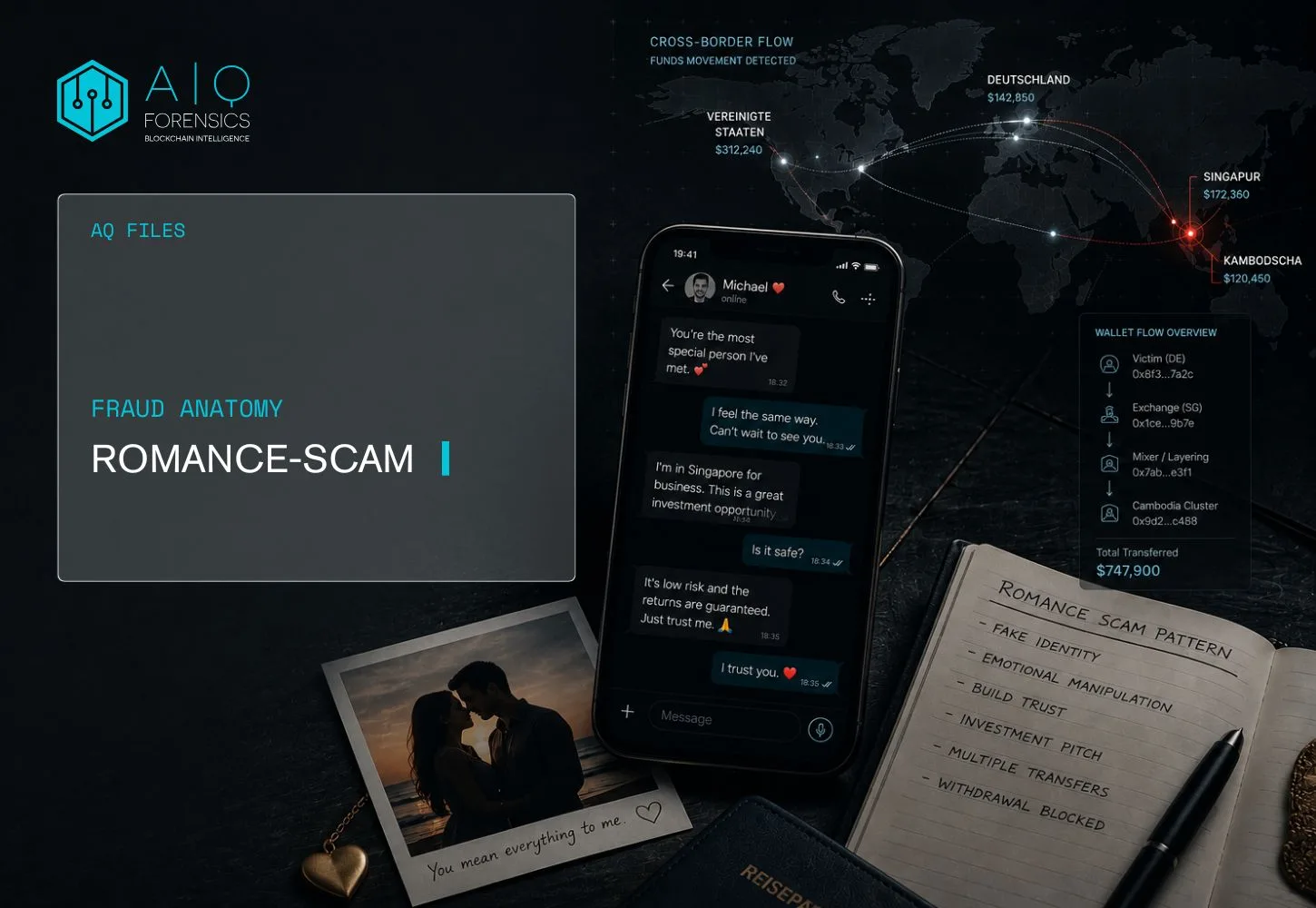
Anatomy of a Romance Scam Involving Cryptocurrencies
How a supposed relationship became international investment fraud
When the client met the supposed financial analyst on an international dating platform, nothing initially pointed to a case of fraud. The woman presented herself as successful, educated and financially independent. She spoke about her career, her family and her plans for the future. Within a few days an intensive contact developed, moving from the dating platform first to WhatsApp and later to Telegram. Short messages became daily conversations. Interest became trust. And trust eventually developed into an emotional bond. Only months later did it emerge that the supposed analyst might never have existed.
The subsequent investigation by AQ Forensics revealed numerous indications of a professionally organised romance scam in which emotional manipulation was deliberately combined with cryptocurrency investments.
Starting position of the case
The first contact was made through a dating platform. The woman stated that she originally came from Asia and now lived in Singapore. According to her own account she worked as an analyst for an internationally active company and, on the side, took an intensive interest in financial markets and cryptocurrencies.
The communication developed unusually quickly. After only a short time both parties exchanged private photographs, held daily conversations and discussed personal matters.
The client later described the communication as extraordinarily intensive.
- Morning messages
- Shared plans for the future
- Personal compliments
- Emotional support
From the client's point of view, a serious relationship was developing. In retrospect, this very phase turned out to be a central component of the later fraud.
Modern romance scams rarely attack technical weaknesses. They exploit trust, emotional closeness and the hope of a shared future.
If you are unsure whether you are affected, have your case examined discreetly. AQ Forensics supports victims with the analysis of international cryptocurrency fraud cases through blockchain forensics, wallet tracking and structured preservation of evidence.
What is a romance scam involving cryptocurrencies?
A romance scam – also known as love fraud – describes a form of fraud in which perpetrators deliberately build emotional relationships in order to obtain financial advantages later.
Unlike classic hacker attacks, romance scammers do not primarily attack technical weaknesses.
They exploit trust. Closeness. Affection. And the hope of a shared future.
Modern romance scams are increasingly combined with cryptocurrency fraud.
First, emotional trust is built. Only once a stable relationship has formed are victims introduced step by step to supposedly exclusive investment opportunities.
Love bombing as the basis of the romance scam
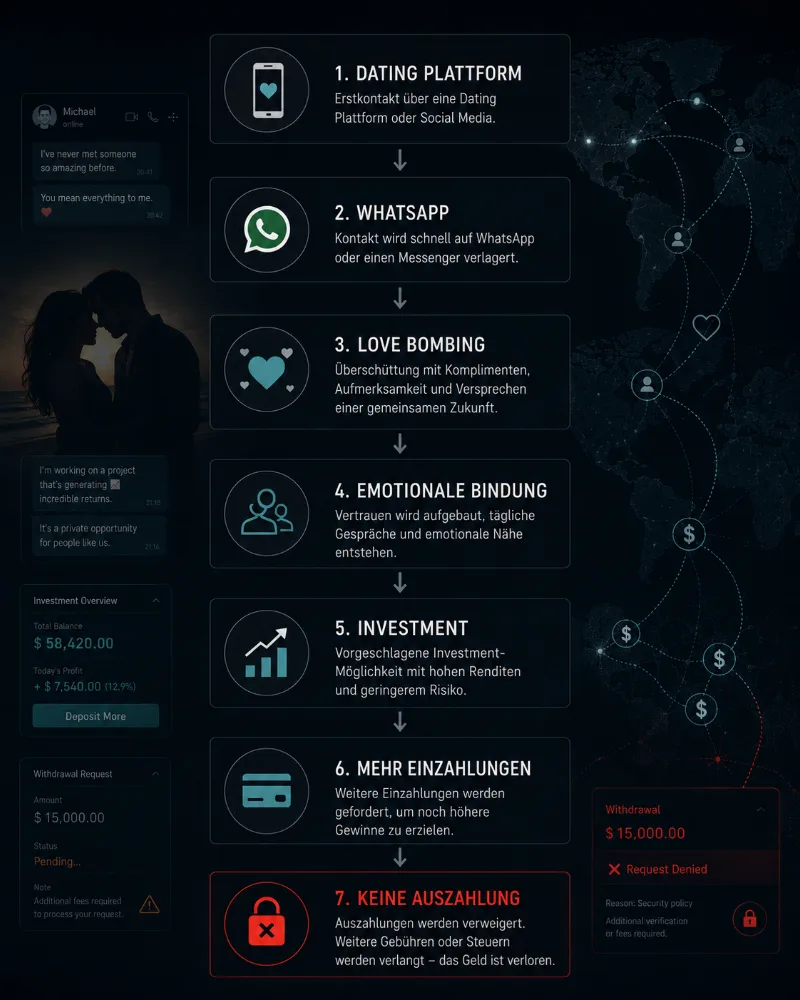
The perpetrator knew how to build an extraordinarily close relationship within a short time. The client received messages every day. Sometimes the communication began in the early morning and continued late into the night. The conversations revolved around family, travel, career, plans for the future and personal wishes.
The perpetrator showed extraordinary interest in the client's life and conveyed the impression of a deep emotional bond.
This method is frequently referred to as love bombing. The aim is to build a relationship of trust within a short time that makes later financial demands appear credible.
The entry into cryptocurrencies
Only once the emotional bond had been consolidated did the perpetrator begin to talk about cryptocurrencies. In doing so she did not present herself as an expert. Instead she regularly referred to a supposedly successful family member with exclusive market knowledge and many years of experience in crypto trading.
The investment idea was not promoted aggressively. Rather, the impression arose that the information was being shared out of personal trust.
It was precisely this circumstance that increased the credibility considerably.
The first investments and the building of trust
The first investments were comparatively small.
In such cases, victims are frequently instructed to acquire cryptocurrencies through regulated exchanges and then transfer them to external trading platforms.
The platforms used look professional and display apparently comprehensible profits, account balances and transaction histories.
In many cases even small withdrawals are permitted.
This gives those affected the impression that the system actually works.
These early experiences of success frequently form the basis for larger investments later.
Blockchain analysis and investigative approaches
After the incident was reported, the blockchain forensic investigation began. The aim was to trace the assets transferred. The analysis concentrated on wallet clustering, transaction tracing, exchange attribution and the identification of possible payout routes.
The investigation identified several wallets closely connected in time with the client's deposits. The assets were then forwarded through various intermediate wallets and partly consolidated with further transaction flows.
The trap closes
As the emotional bond grew, the dynamic changed. The conversations now turned increasingly to shared plans for the future, financial freedom and long-term investments. At the same time the investments grew larger.
The stronger the emotional relationship became, the smaller the critical distance towards the investment recommendations.
Once substantial assets had been invested, the situation suddenly changed:
- withdrawals were made difficult
- additional fees were demanded
- taxes supposedly had to be paid in advance
- new verifications became necessary
- further deposits were demanded
The platform continued to display high profits. Actual access to the assets was, however, no longer possible.
At this point the client became aware for the first time that he might have become the victim of fraud.
The perpetrators attacked no technical weaknesses. They exploited trust, emotional closeness and the hope of a shared future.
What those affected by a romance scam involving cryptocurrencies should do
Where cryptocurrency fraud is suspected, AQ Forensics recommends in particular:
- Make no further payments
- Secure all chat histories
- document wallet addresses
- archive transaction data
- Check the platform used
- Have a blockchain analysis carried out early
- Secure records of communication in full
If you already have a suspicion or have become the victim of crypto fraud, contact AQ Forensics for a professional analysis and the preservation of evidence of your transactions.
Have your case examined without obligation
We analyse your case confidentially and discuss together which measures and next steps are possible.
Closing remarks
Romance scams are today among the most successful forms of international cryptocurrency fraud.
The perpetrators primarily exploit not technical weaknesses but human needs for closeness, trust and emotional connection.
It is precisely the combination of a romantic relationship, supposed financial expertise and professionally designed crypto platforms that makes this form of fraud so dangerous.
At the same time, this case shows that blockchain forensic analysis and technical investigative measures can deliver valuable findings even against internationally organised perpetrator structures.
Über den Autor
Albert Quehenberger leads international investigations in the fields of cryptocurrency fraud, blockchain forensics and digital asset analysis.
His work focuses on the analysis of transnational scam infrastructure, wallet tracking, money laundering processes and the structured investigation of organised crypto crime.

Further cases from the AQ Fraud Intelligence Library
- // AQ FILES 001 – Anatomy of an international pig butchering fraud
- // AQ FILES 003 – Anatomy of an international crypto Ponzi scheme
- // AQ FILES 004 – Anatomy of a RIP deal involving cryptocurrencies