
OFAC Sanctions Alleged ISIS Financiers with Links to Cryptocurrencies
New sanctions against international money transfer networks underline the growing importance of blockchain analysis, wallet screening and compliance measures in combating terrorist financing structures.
Combating terrorist financing networks is one of the central challenges facing international financial supervisory and law enforcement authorities. While conventional money transfer structures continue to play a significant role, cryptocurrencies and public blockchains are becoming increasingly important.
The current sanctions imposed by the Office of Foreign Assets Control (OFAC) on alleged ISIS financiers show that blockchain addresses are now a fixed component of international sanctions measures. At the same time, the case underlines the growing importance of wallet screening, blockchain analysis and regulatory compliance for banks, crypto exchanges, virtual asset service providers (VASPs) and investigative authorities.
International money transfer networks in focus
On 22 June 2026, the Office of Foreign Assets Control (OFAC) of the US Treasury Department imposed sanctions on three individuals and six companies which, according to the US authorities, are said to have supported financial transactions for the benefit of the terrorist organisation „Islamic State“ (ISIS).
The measures are directed against an international network of money transfer service providers and financial intermediaries in Europe, the Middle East and Africa which, in the assessment of the US authorities, contributed to the financing of ISIS.
The sanctioned companies include in particular the Syria-based money transfer platform Bitcoin Xchange, which according to OFAC has been active since the end of 2020. The US authorities accuse the company of having transferred funds for individuals with links to ISIS from various countries, including Norway, Belgium, the Netherlands, South Africa and the United States.
Also affected are the Turkish money transfer companies Spider Gayrimenkul Ve Genel Ticaret Limited Sirketi and Alkaram Danismanlik Gayrimenkul Ic Ve Dis Genel Ticaret Limited Sirketi. According to the US Treasury Department, these companies are said to have been used in the past for money transfers connected with ISIS.
In addition, the Nigerian companies Nine to Nine Exchange Bureau de Change Limited, Manhattan Bureau de Change Limited and Generation Currency Bureau de Change Limited were placed on the sanctions list. According to OFAC, the companies are said to be under the control of an alleged ISIS financier in West Africa.
Cryptocurrencies remain part of terrorist financing structures
The current measure shows once again that while cryptocurrencies account for only part of terrorist financing, they continue to be used by extremist networks to carry out cross-border movements of money. As part of the sanctions, OFAC also published two TRON wallet addresses attributed to a French national who, according to the US authorities, is said to have carried out financial transactions for actors close to ISIS.
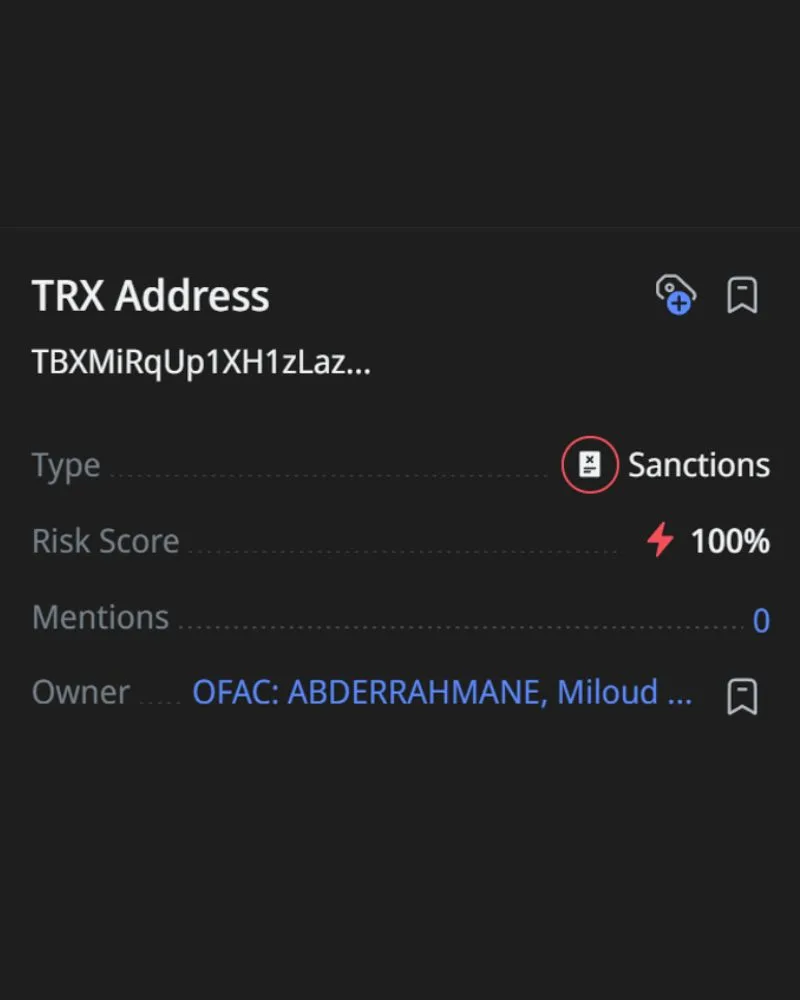
The publication of specific blockchain addresses enables cryptocurrency exchanges, wallet providers and other financial intermediaries to identify potentially affected transactions and to initiate appropriate compliance measures. The blockchain analysis required for this now forms a central component of modern sanctions and compliance processes.
„Blockchain addresses are increasingly becoming a fixed component of international sanctions and compliance measures.“
Significance for crypto exchanges and compliance departments
For virtual asset service providers (VASPs), crypto exchanges and financial institutions, the OFAC measure means an immediate adjustment of their sanctions checks and transaction monitoring systems.
As soon as wallet addresses are officially published by sanctions authorities, the institutions concerned have to ensure that transactions involving these addresses are detected, examined and, where necessary, blocked.
Beyond that, indirect connections to sanctioned individuals or companies also have to be taken into account. This is particularly relevant against the background of so-called secondary sanctions. International financial service providers that continue to maintain business relationships with sanctioned actors or process their transactions risk being sanctioned themselves or being excluded from the US financial system.
Blockchain analysis as an instrument of counter-terrorism
The case again illustrates the growing importance of blockchain analysis in combating terrorist financing, money laundering and other forms of cross-border financial crime.
While conventional money transfer networks such as hawala systems continue to play an important role, public blockchains increasingly enable investigative authorities to trace payment flows across national borders.
The current sanctions are based on investigations and analyses by various US authorities. In addition, several providers of blockchain analysis software, including Chainalysis, have evaluated the published sanctions information and integrated it into their compliance systems.
Lassen Sie Ihren Fall unverbindlich prüfen
AQ Forensics supports in handling complex crypto incidents – from blockchain forensics and operational incident response to securing and recovering digital assets.
In context
The latest OFAC sanctions show that terrorist organisations continue to attempt to use both traditional money transfer channels and cryptocurrencies for their financing.
At the same time, the case underlines the growing importance of international cooperation, regulatory measures and blockchain-based investigative instruments in combating terrorist financing networks.
The publication of official blockchain addresses by sanctions authorities also makes clear that wallet screening and blockchain analysis have now become a fixed component of modern compliance and sanctions processes. For banks, crypto exchanges, virtual asset service providers (VASPs) and other financial intermediaries, the continuous monitoring of blockchain-based transactions is therefore becoming ever more important.
AQ Forensics supports banks, crypto exchanges, companies, authorities and compliance departments with blockchain analysis, wallet screening, sanctions checks and the forensic investigation of complex cryptocurrency transactions.
Über den Autor
Albert Quehenberger is founder and managing director of AQ Forensics GmbH and a specialist in blockchain forensics, cryptocurrency investigations and digital asset analysis. With more than a decade of experience in intelligence, digital investigations and blockchain analysis, he supports companies, banks, lawyers, authorities and private individuals in investigating crypto fraud cases, asset tracing and analysing complex financial flows on public blockchains.
His career includes more than six years in military intelligence, a master's degree from the WU Executive Academy, specialist training for court-appointed experts and training as an election observer to OSCE/ODIHR standards. He is also a member of the expert council of the European Institute for Future Generations (EIFG), a ChangeNOW ambassador and an adviser for Web3 education programmes in Ethiopia.

Sources & further information
- U.S. Department of the Treasury – Office of Foreign Assets Control (OFAC)
- Chainalysis – OFAC sanctions ISIS financial facilitators
Further analyses & case studies
- // AQ INTELLIGENCE 001 – Russian sanctions evasion using cryptocurrencies
- // AQ INSIGHTS 002 – Crypto mixers in blockchain forensics
- // AQ ECOSYSTEM 002 – TokenPay and AQ Forensics enter into a strategic partnership